Country club and tournament locker room flooring fails prematurely when specifiers treat the changing facility as a uniform interior finish zone. In the dry dressing bays and shoe-care vestibule, golfers returning from 18 holes walk and pivot in cleated golf shoes that concentrate 300 to 600+ psi (2.1 to 4.1 MPa) of rotational point load while grinding angular USGA topdressing silica sand (Mohs hardness 7.0) and ferric sulfate turf chemicals into carpet fibers and elastomeric seams. Thirty feet away in the barefoot toweling buffer and shower core, the hazard reverses: players step out of 105°F (40.5°C) showers onto sloped wet tiles coated in emulsified skin sebum, shampoo surfactants, and insoluble calcium stearate soap scum—a viscous hydrodynamic film that causes bare heels to aquaplane on standard 0.42 DCOF commercial tiles.
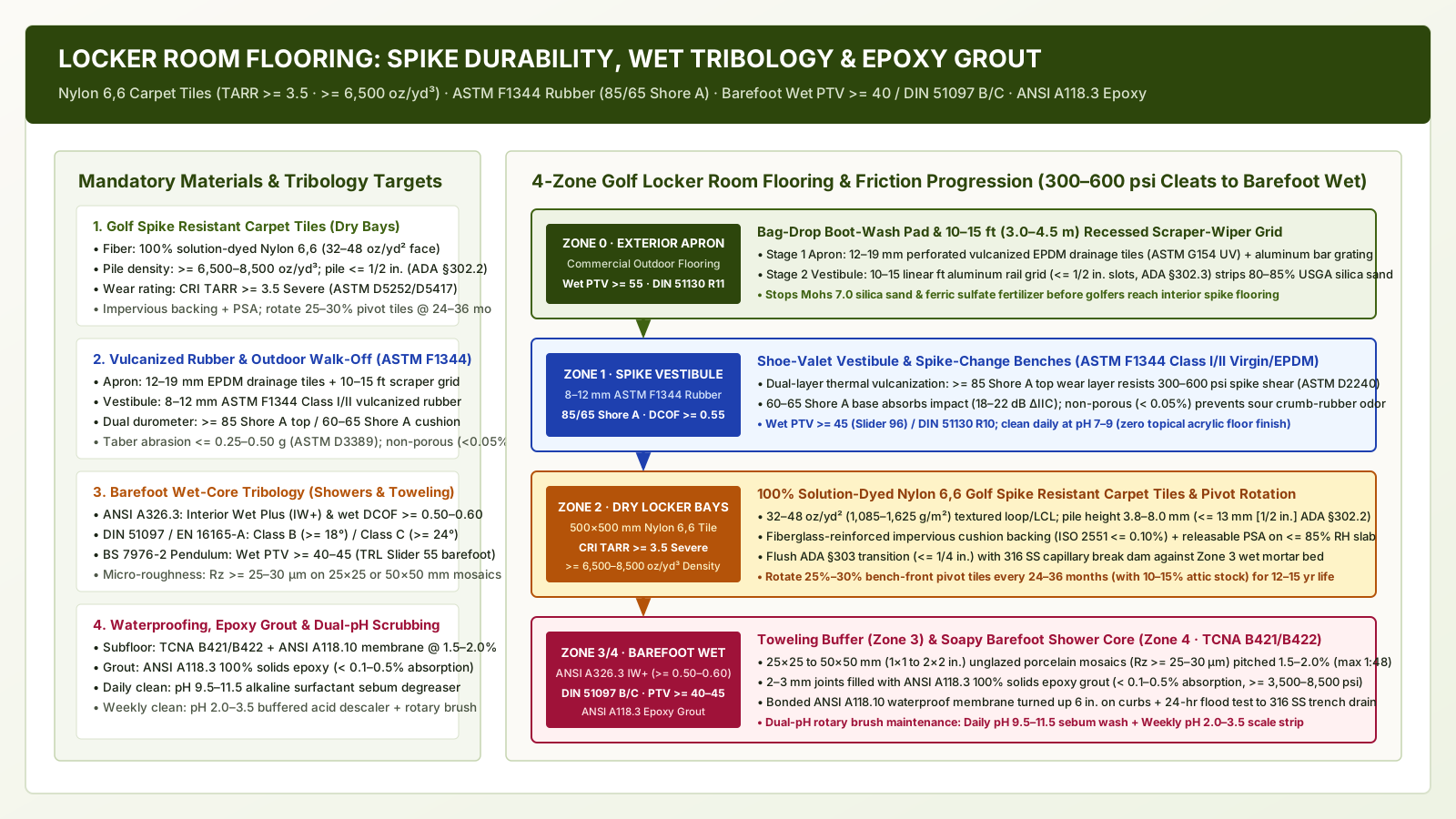
Engineering a durable, slip-resistant floor assembly requires dividing the facility into four distinct tribological zones:
- Zone 0 (Exterior Bag-Drop Apron & Walk-Off Threshold): Heavy-duty commercial outdoor flooring (
12 to 19 mmperforated vulcanized EPDM drainage tiles and serrated aluminum bar grating withwet PTV >= 55/DIN 51130 R11–R12) paired with a10 to 15 ft(3.0 to 4.5 m) recessed scraper-wiper grid that strips80% to 85%of coarse mud and bunker sand before players cross the threshold. - Zone 1 (Spike-Change Vestibule & Shoe Valet):
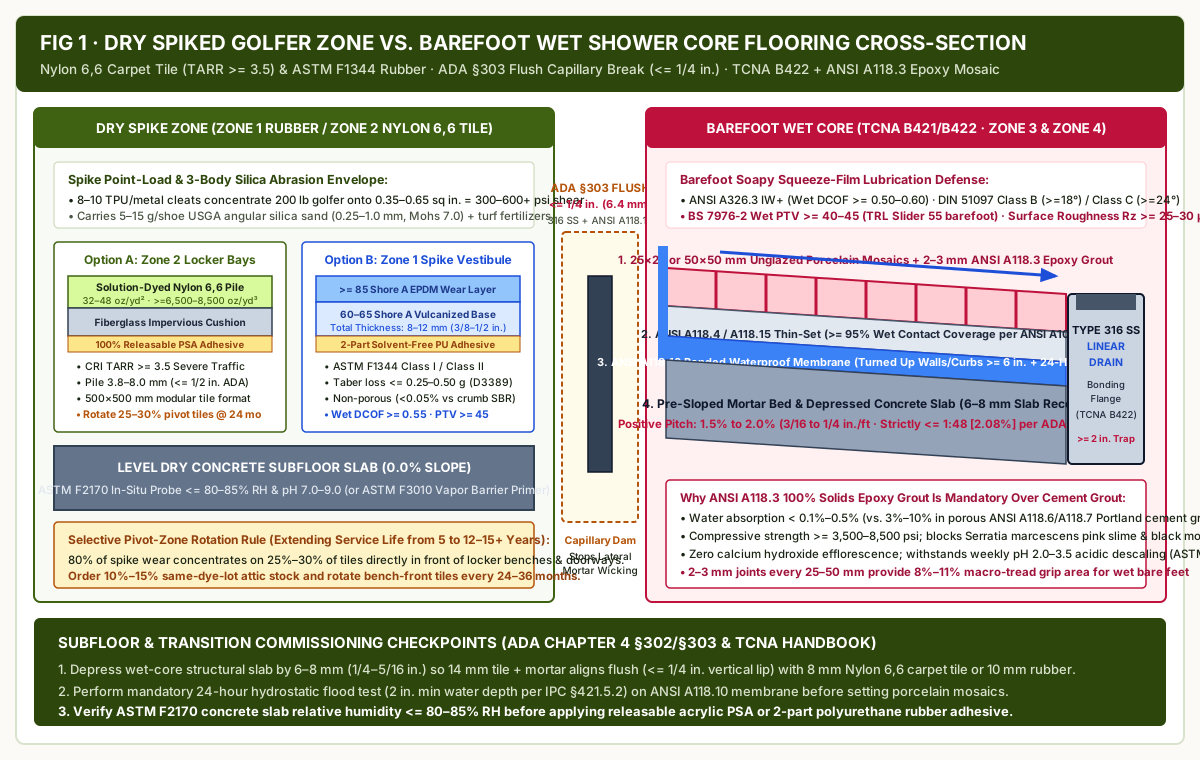
8 to 12 mm(3/8 to 1/2 in.) ASTM F1344 Class I/II vulcanized virgin/EPDM rubber flooring combining an>= 85 Shore Acleat-resistant top wear layer (ASTM D2240 Grade 1) over a60 to 65 Shore Ashock-absorbing cushion base (wet DCOF >= 0.55,wet PTV >= 45withSlider 96). - Zone 2 (Dry Member Locker Bays & Card Lounge):
500 × 500 mm(19.69 × 19.69 in.)100%solution-dyed Nylon 6,6 golf spike resistant carpet tiles engineered to32 to 48 oz/yd²(1,085 to 1,625 g/m²) face weight,>= 6,500 to 8,500 oz/yd³volumetric pile density, and a Carpet and Rug InstituteCRI TARR >= 3.5(Severe Traffic) rating with fiberglass-reinforced impervious cushion backing and25% to 30%bench-front pivot-tile rotation every24 to 36 months. - Zone 3 & Zone 4 (Barefoot Toweling Buffer & Wet Shower Core): Small-format unglazed thru-body porcelain mosaics (
25 × 25 mmto50 × 50 mm[1 × 1to2 × 2 in.]) pitched at1.5% to 2.0%(max 1:48perADA §608.7) over an ANSI A118.10 load-bearing bonded waterproof membrane (TCNA Method B421/B422), certified to ANSI A326.3 Interior Wet Plus (IW+, wetDCOF >= 0.50–0.60), DIN 51097 Class B (>= 18°) / Class C (>= 24°), BS 7976-2 wet PendulumPTV >= 40 to 45(TRL Slider 55barefoot), and surface micro-roughnessRz >= 25 to 30 µm, grouted with ANSI A118.3100%solids epoxy grout (< 0.1%–0.5%water absorption) and maintained via daily alkaline (pH 9.5–11.5) and weekly buffered acidic (pH 2.0–3.5) cylindrical-brush scrubbing.
Where our parent threshold inspection note clubhouse walls and floors where mud meets the building establishes the exterior boot-wash, mat, and hard-floor doorway sequence under clubhouse design, and our supporting walk-through checklist changing rooms: benches, hooks and water on the tile frames the initial site questions within sports facilities, this specification reference delivers the material testing standards, friction equations, and subfloor assemblies that complement the 8 to 10 ACH negative-pressure HVAC cascade, 100 to 150 mm raised locker plinths, and NEC Article 210.8(B) GFCI vanity layout detailed in locker room design: negative-pressure ventilation, wet-zone separation, benches, and plinth lockers.
| Locker Room Zone | Recommended Flooring System | Mechanical & Wear Specification | Multi-Standard Slip Resistance Target | Cleaning & Lifecycle Protocol |
|---|---|---|---|---|
Zone 0: Exterior Bag-Drop Apron & Threshold (Commercial Outdoor Flooring) |
Perforated vulcanized EPDM drainage tiles (12–19 mm) + serrated aluminum bar grating & 10–15 ft scraper-wiper grid |
UV-stabilized (ASTM G154); <= 1/2 in. grate slots (ADA §302.3); captures 80%–85% sand/water in 6–8 steps |
Wet PTV >= 55 (Slider 96); DIN 51130 R11 / R12; positive 1.5%–2.0% exterior pitch |
Daily pressure-hose pan flush; weekly HEPA vacuuming and rotary extraction of wiper strips |
| Zone 1: Spike-Change Vestibule, Shoe Valet & Corridor | Vulcanized Virgin/EPDM Rubber Tile or Sheet (ASTM F1344 Class I/II, 8–12 mm [3/8–1/2 in.] thick) |
Dual-durometer >= 85 Shore A wear layer over 60–65 Shore A base (ASTM D2240); Taber loss <= 0.25–0.50 g (ASTM D3389) |
Wet ANSI A326.3 DCOF >= 0.55; Wet PTV >= 45 (Slider 96); DIN 51130 R10 |
Daily neutral/mild-alkaline (pH 7.0–9.0) auto-scrubber with soft nylon brush; zero acrylic floor wax |
| Zone 2: Dry Member Locker Bays & Card Lounge | 100% Solution-Dyed Nylon 6,6 Golf Spike Resistant Carpet Tiles (500 × 500 mm, impervious cushion backing) |
Face weight 32–48 oz/yd² (1,085–1,625 g/m²); density >= 6,500–8,500 oz/yd³; CRI TARR >= 3.5 Severe; pile <= 1/2 in. (ADA §302.2) |
Dry/Damp DCOF >= 0.60; ADA §302.2 firm, stable, slip-resistant textile; 0.0% floor slope |
Daily CRI dual-motor HEPA beater vacuum; quarterly hot-water extraction; rotate 25%–30% pivot tiles @ 24–36 mo |
Zone 3: Toweling Buffer & Grooming Vanity Alcove (Barefoot Damp) |
Unglazed Textured Thru-Body Porcelain Tile (<= 150 × 150 mm or 50 × 50 mm) + ANSI A118.3 Epoxy Grout |
Water absorption <= 0.5% (ASTM C373); ANSI A118.10 bonded membrane; 1.0%–1.5% (1:80) pitch to trench drain |
ANSI A326.3 IW+ (wet DCOF >= 0.50); DIN 51097 Class B (>= 18°); Wet PTV >= 36–42 (Slider 55); Rz >= 20–25 µm |
Daily alkaline sebum scrub (pH 9.5–11.5) + wet-vac pickup; weekly buffered acid descale (pH 2.0–3.5) |
Zone 4: Wet Shower Stalls & Steam Core (Barefoot Soapy Wet) |
Small-Format Unglazed Porcelain Mosaics (25 × 25 mm to 50 × 50 mm [1 × 1 to 2 × 2 in.]) + 2–3 mm ANSI A118.3 Epoxy Joints |
TCNA B421 / B422 receptor over ANSI A118.10 membrane; 1.5%–2.0% (max 1:48 per ADA §608.7) pitch to 316 SS linear drain |
ANSI A326.3 IW+ (wet DCOF >= 0.50–0.60); DIN 51097 Class B (>= 18°) / Class C (>= 24°); Wet PTV >= 40–45 (Slider 55); Rz >= 25–30 µm |
Daily rotary cylindrical brush alkaline wash (8–10 min dwell) + rinse; weekly phosphoric/sulfamic acid strip |
1. Dry-Zone Spike Durability: Solution-Dyed Nylon 6,6 Carpet Tiles (CRI TARR >= 3.5) vs. ASTM F1344 Vulcanized Rubber and Commercial Outdoor Flooring
Key takeaway: Stop 80% to 85% of tracked USGA silica sand at the building perimeter with a 10 to 15 ft commercial outdoor flooring and recessed scraper-wiper sequence, surface the Zone 1 shoe-care vestibule in 8 to 12 mm ASTM F1344 dual-durometer vulcanized virgin/EPDM rubber (>= 85 Shore A top wear layer over 60 to 65 Shore A base), and specify 500 × 500 mm 100% solution-dyed Nylon 6,6 golf spike resistant carpet tiles (32 to 48 oz/yd² face weight, >= 6,500 to 8,500 oz/yd³ pile density, CRI TARR >= 3.5 Severe Traffic rating, impervious cushion backing, and 25% to 30% bench-front pivot rotation) across Zone 2 dry locker bays.
Biomechanics of Golf Spike Point Loading and Three-Body Silica Sand Abrasion
Standard commercial office carpet, luxury vinyl tile (LVT), and recycled crumb-rubber gym mats fail rapidly in golf clubhouses because specifiers underestimate the contact mechanics of golf footwear. Whereas a flat rubber-soled athletic shoe distributes a pedestrian’s weight across 8 to 12 sq in. (52 to 77 cm²) at a modest contact pressure of 15 to 30 psi (103 to 207 kPa), modern multi-durometer thermoplastic polyurethane (TPU) soft spikes (8 to 10 cleats per shoe, each molded with 4 to 6 radial traction lugs at Shore A 85–95 / Shore D 45–55 hardness) and heritage 8 mm steel/ceramic tournament spikes concentrate a 90 kg (200 lb) golfer’s heel-strike and rotational pivot force onto an effective lug contact area of just 0.35 to 0.65 sq in. (2.2 to 4.2 cm²).
During a single 45° to 90° rotational pivot as a player stands up from a locker bench or turns at a doorway, golf cleats generate 300 to 600+ psi (2.1 to 4.1 MPa) of localized compressive stress paired with high-torque horizontal shear. Worse, cleats do not act alone: golfers returning from 18 holes carry 5 to 15 grams per shoe of angular USGA rootzone topdressing silica sand (particle diameter 0.25 to 1.0 mm, Mohs hardness 7.0), damp bentgrass or bermudagrass clippings, liquid chelated iron (ferric/ferrous sulfate), and selective turf herbicides. When ground beneath 300 to 600 psi spike lugs, Mohs 7.0 quartz grains act as a three-body industrial abrasive that severs low-density olefin or polyester carpet loops (zippering), delaminates residential woven backings, and gouges unvulcanized PVC wear layers.
Three-Stage Commercial Outdoor Flooring Walk-Off Transition (Zone 0 to Zone 1)
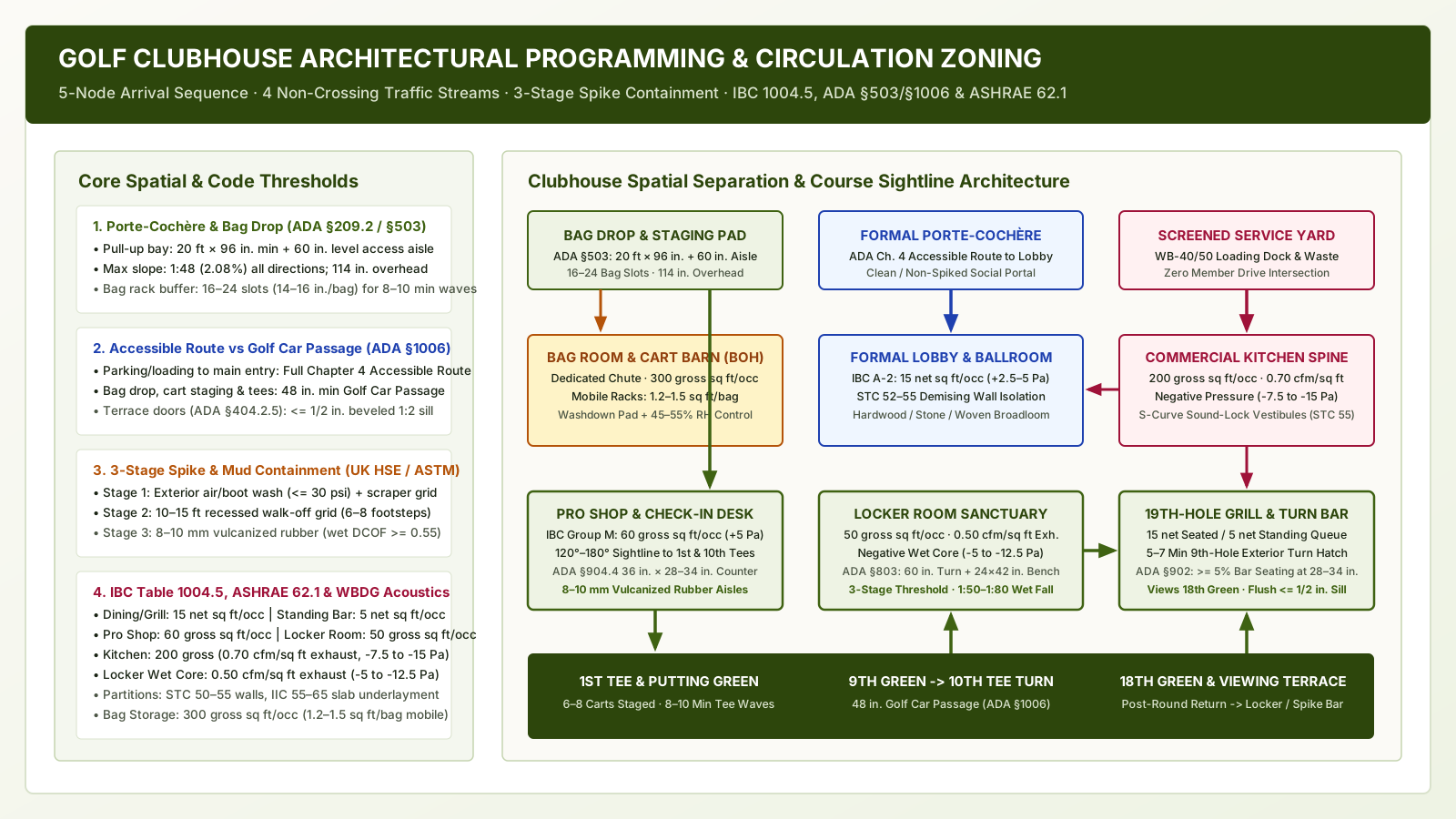
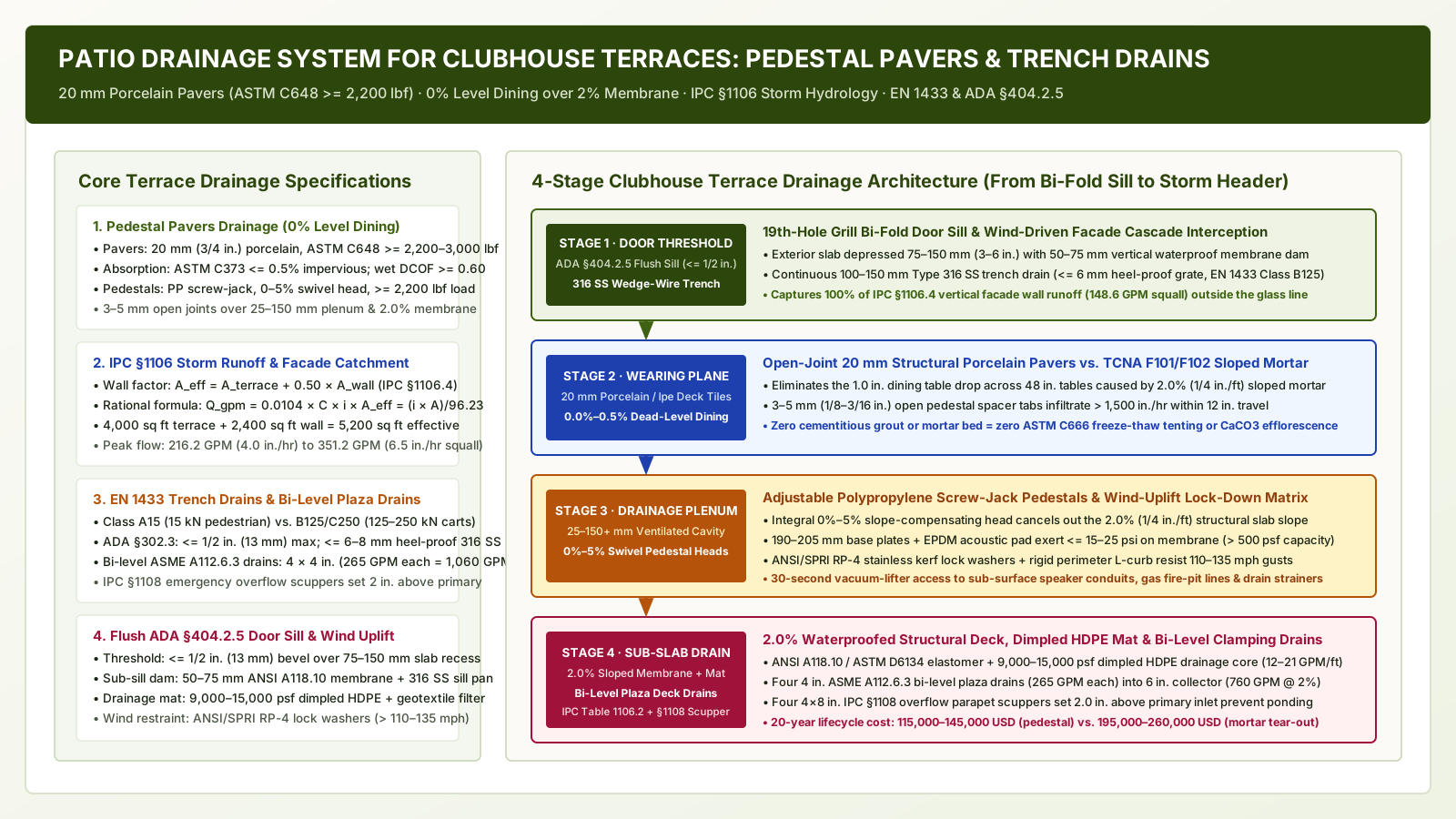
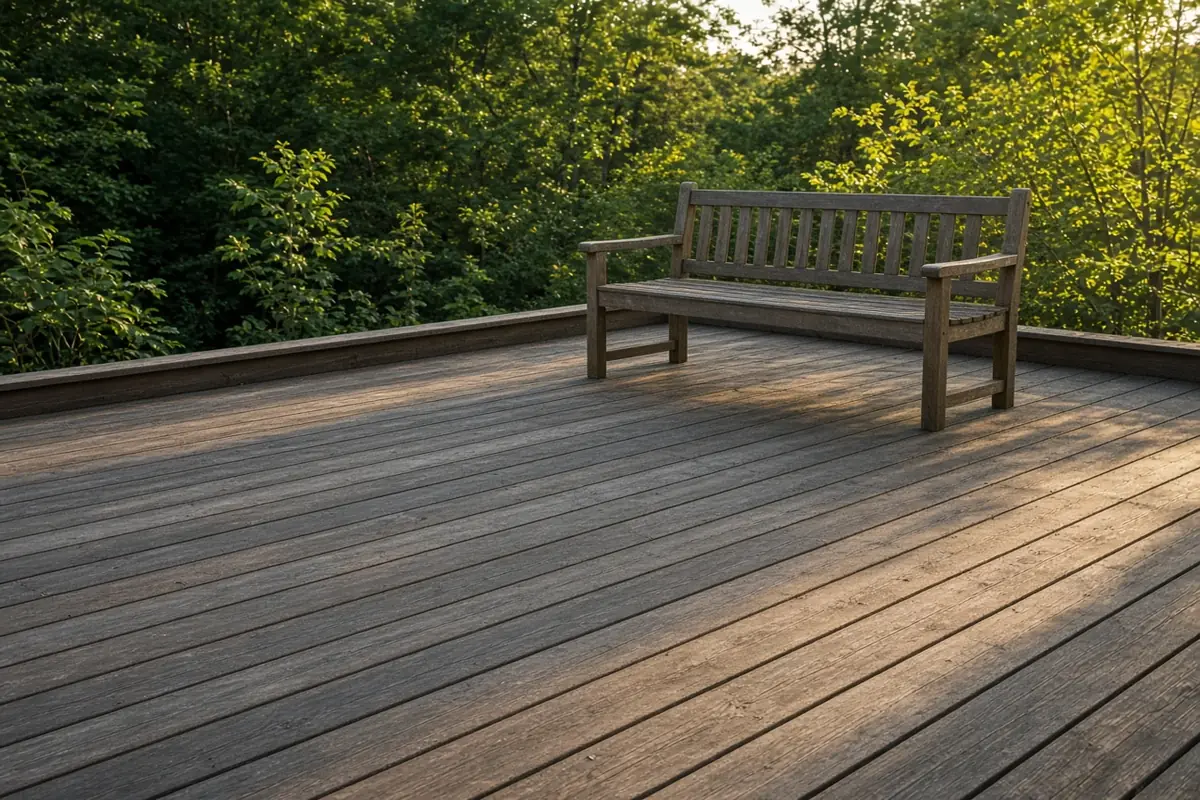
Before spiked golfers set foot on interior locker room flooring, the exterior-to-interior arrival portal connecting the bag drop and cart staging apron—mapped across the building envelope in golf clubhouse design: arrival sequence, spike-proof circulation zones, and member-visitor flow, contrasted with timber board drainage in outdoor decks at a club: boards, water and frost, and paired on the dining deck with patio drainage systems for clubhouse terraces—must deploy a three-stage commercial outdoor flooring walk-off sequence engineered to capture 80% to 85% of tracked sand and rainwater over 6 to 8 footsteps (10 to 15 linear feet / 3.0 to 4.5 m):
- Stage 1 — Semi-Exposed Golfer Apron & Compressed-Air Boot-Wash Pad (
Exterior Commercial Outdoor Flooring): Immediately outside the golfer mudroom door, install12 to 19 mm(1/2 to 3/4 in.) interlocking perforated vulcanized EPDM/SBR drainage tiles (molded with4 to 6 mmunderside drainage studs, beveled safety edges, and carbon-black/hindered-amine UV stabilization tested toASTM G154) set over a1.5% to 2.0%sloped concrete slab (wet PTV >= 55), flanked by a38 mm(1.5 in.) deep serrated architectural aluminum bar-grating pit (<= 1/2 in.[13 mm] slot openings perADA §302.3, drained via a2 in.trapped sediment bucket) at the compressed-air rotary bristle shoe cleaner. - Stage 2 — Recessed Vestibule Scraper-Wiper Grid (
10 to 15 Linear Feet/3.0 to 4.5 m): Inside the weather-locked vestibule, recess a heavy-duty extruded aluminum rail grid (ADA §302.3slots oriented strictly perpendicular to the direction of travel) alternating serrated EPDM/silicon-carbide scraper bars with36 to 42 oz/yd²solution-dyed monofilament nylon wiper strips over a drained concrete pan. - Stage 3 — Flush Interior Spike-Zone Transition (
ADA §303 <= 1/4 in.): Transitions flush across an anodized aluminum or stainless steel edge frame directly into Zone 1 (8 to 12 mmvulcanized rubber) or Zone 2 (500 × 500 mmNylon 6,6 golf spike resistant carpet tiles).
Seven Mandatory Engineering Specifications for Golf Spike Resistant Carpet Tiles (Zone 2)
In private country club dry locker bays and member card lounges where acoustic warmth (NRC >= 0.25–0.35, IIC >= 60–65) and underfoot comfort are required, broadloom roll carpet and commodity commercial carpet tiles (Nylon 6, PET polyester, or polypropylene/olefin) fail within 18 to 36 months. Spike lugs snag low-twist continuous loops, crush low-density pile into permanent matted lanes in front of locker benches, and force facility managers to unbolt entire locker banks to replace a worn 3 ft (0.9 m) aisle strip.
To achieve a 12 to 15+ year service life under cleated foot traffic, specifiers must enforce seven quantitative parameters for golf spike resistant carpet tiles based on the Carpet and Rug Institute (CRI) Texture Appearance Retention Rating (TARR) standard and U.S. Access Board ADA Chapter 4 (§302.2 Carpet):
- 100% Solution-Dyed Nylon 6,6 (
Polyamide 6,6) Face Fiber: Never specifyNylon 6, polyester (PET), or olefin.Nylon 6,6is polymerized from hexamethylenediamine and adipic acid, creating a tighter hydrogen-bonded molecular crystalline structure and a45°Chigher melting point (260°Cvs.215°CforNylon 6) that recovers90% to 95%of its uncompressed pile height after300 to 600 psispike loading. Solution dyeing (100%pre-extrusion pigment compounding) locks color throughout the entire fiber cross-section (AATCC 16E >= 4.0lightfastness;AATCC 165 >= 4.0crocking), rendering the carpet impervious to bleach, hydrogen peroxide spotters, and ferric sulfate turfgrass iron stains. - Dense Textured Loop, Tip-Sheared Loop, or Level-Cut/Loop (
LCL) Pile Geometry (ADA §302.2): Specify a tightly packed multi-level textured loop, micro-sheared loop, or dense level-cut/loop (LCL) construction with high-twist heat-set plied yarns (4.5 to 6.0 twists per inch) and a finished pile height of0.15 to 0.31 in.(3.8 to 8.0 mm)—strictly below the0.50 in.(13 mm) federal maximum mandated by 2010 ADA Standards Section 302.2. Require a minimum tuft bind of>= 8.0 to 10.0 lbf(35.6 to 44.5 N) under ASTM D1335 (vs. 3.0 lbfstandard commercial cut-pile minimum) so rotational spike lugs cannot hook and pull yarn tufts free. - Face Weight (
32–48 oz/yd²) and Volumetric Tuft Density (>= 6,500–8,500 oz/yd³perASTM D5848): Face weight alone can be deceptive if the pile is tall and loose. In spike zones, specify a tufted face weight of32 to 48 oz/yd²(1,085 to 1,625 g/m²), a machine gauge of1/10 to 1/12 in.(39.4 to 47.2 ends per 10 cm), a stitch rate of9.0 to 12.0 stitches per inch, and a minimum volumetric pile density of>= 6,500 to 8,500 oz/yd³(>= 0.24 to 0.31 g/cm³). High volumetric density packs vertical Nylon 6,6 tufts shoulder-to-shoulder (columnar support), forcing cleats to walk across the resilient fiber tips rather than parting the pile and shredding the primary backing. CRI TARR >= 3.5(Severe Traffic) & Dynamic Golf-Spike Drum Testing (ASTM D5252/D5417): Under the Carpet and Rug Institute (CRI) appearance retention scale evaluated via ASTM D5252 (12,000-cycleHexapod drum tumbler) or ASTM D5417 (Vettermann drum), commercial carpets are graded asModerate Traffic (TARR >= 2.5),Heavy Traffic (TARR >= 3.0), orSevere Traffic (TARR >= 3.5). Locker room specifications must mandateCRI TARR >= 3.5, supplemented by manufacturer armed golf-spike drum / dynamic cleat wheel testing (>= 10,000 to 25,000 spiked passeswith appearance retention>= 3.0 to 3.5and zero backing exposure).500 × 500 mmModular Format with Fiberglass-Reinforced Impervious Cushion Backing (ISO 2551): Specify500 × 500 mm(19.69 × 19.69 in.) or610 × 610 mm(24 × 24 in.) modular tiles laminated to a non-woven fiberglass-reinforced composite vinyl, modified bitumen, or closed-cell thermoplastic polyolefin (TPO) impervious moisture-barrier cushion backing (dimensional stability <= 0.10%growth/shrinkage perISO 2551 / EN 986 Aachen test;ASTM E648 Class ICritical Radiant Flux>= 0.45 W/cm²;ASTM E662smoke density<= 450). The impervious backing stops wet-shoe drippings and post-shower damp foot moisture from penetrating to the concrete slab, while the integral closed-cell cushion absorbs cleat impact energy (reducing fiber tip crushing by 30%–40%).- 100% Releasable Pressure-Sensitive Adhesive (
PSA) Over Moisture-Tested Slabs (ASTM F2170): Install tiles in a Quarter-Turn (Parquet) or Ashlar/Monolithic pattern using100%full-spread releasable acrylic pressure-sensitive adhesive (PSA) or floating corner-connector tabs over concrete subfloors verified via ASTM F2170 in-situ relative humidity probes at<= 80% to 85% RHand slab surfacepH 7.0 to 9.0(applying anASTM F3010two-part 100% solids epoxy moisture-mitigation primer if slab RH exceeds85%). - 25%–30% Bench-Front Pivot-Tile Rotation & 10%–15% Attic Stock Protocol: Require the contractor to deliver
10% to 15%extra attic stock from the identical production dye lot at substantial completion, and write a mandatory 24-to-36-month pivot-zone rotation schedule into the club’s operations manual.
Cleat Point Pressure (P_cleat_psi) = (W_golfer_lb * f_dynamic) / A_active_cleats_sqin
Volumetric Pile Density (D_pile_oz_yd3) = (36 * W_face_oz_yd2) / H_pile_in
15-Year Broadloom TCO (USD) = N_replacements * A_room_sy * (C_material_sy + C_install_sy + C_locker_demo_sy)
15-Year Modular Tile Rotation TCO (USD) = [A_room_sy * 1.12 * C_tile_sy] + [A_room_sy * C_install_sy] + [N_rotations * (0.28 * A_room_sy) * C_rotate_labor_sy]
Worked Spike-Load, Pile Density & 15-Year Lifecycle TCO Calculation (3,000 sq ft Dry Locker Bay)
Consider a 3,000 sq ft (333.3 sq yd / 278.7 m²) Country Club Men’s Dry Locker Room (Zone 2) serving 35,000 rounds per year:
-
Step 1 — Golf Cleat Contact Stress Verification:
- A
200 lb(90.7 kg) golfer pivots on one heel/forefoot during shoe removal (dynamic vertical load factor f_dynamic = 1.35, yielding270 lbfnormal load across5 active cleatswith a combined lug tip contact area ofA_active = 0.50 sq in.): P_cleat_psi = 270 lbf / 0.50 sq in. = 540 psi (3.72 MPa)(18 to 27 times higherthan a20–30 psistreet shoe).
- A
-
Step 2 — Carpet Tile Volumetric Pile Density Verification (
ASTM D5848):- Comparing a standard commercial carpet tile (
24 oz/yd²face weight,0.25 in.pile height) against a specified Golf Spike Resistant Carpet Tile (42 oz/yd²solution-dyed Nylon 6,6 face weight,0.21 in.[5.3 mm] finished pile height): Standard Commercial Tile Density = (36 * 24 oz/yd²) / 0.25 in. = 3,456 oz/yd³(Fails — cleats part tufts and shred primary backing within18 months).Golf Spike Resistant Tile Density = (36 * 42 oz/yd²) / 0.21 in. = 7,200 oz/yd³(Passes>= 6,500 oz/yd³benchmark withCRI TARR >= 3.5 Severerating and<= 0.50 in.ADA §302.2compliance).
- Comparing a standard commercial carpet tile (
-
Step 3 — 15-Year Total Cost of Ownership (
TCOinUSD): Broadloom vs. Rotated Modular Carpet Tile:- Option A — Spike-Rated Broadloom Roll Carpet (
Replaced Every 5 Years=3 Full Cyclesover 15 Years): Because80%of spike wear concentrates on the28%(93.3 sq yd) of floor area directly in front of the locker benches and entry vestibule, broadloom develops unsightly matted pivot trenches by Year 5. Replacing broadloom across333.3 sq yd(plus 12% roll waste = 373.3 sq yd) at65 USD/sq ydmaterial (24,265 USD),18 USD/sq ydglue-down tear-out/installation (6,000 USD), and12 USD/sq ydmillwork/bench removal and resetting (4,000 USD) costs34,265 USDper cycle × 3 cycles =102,795 USDover 15 years (plus15 to 21 daysof locker room shutdown). - Option B —
500 × 500 mmSolution-Dyed Nylon 6,6 Carpet Tile (12% Attic Stock+28% Pivot Rotation at Years 3, 6, 9, and 12): Initial procurement of333.3 sq yd * 1.12 (includes 4% cut waste + 8% attic stock) = 373.3 sq ydat72 USD/sq yd(26,878 USD) plus14 USD/sq ydreleasable PSA installation (4,666 USD) equals31,544 USDat Year 0. Every3 years(4 rotationsover 15 years), facilities staff swap the93.3 sq yd(28%) of high-wear bench-front tiles with low-wear perimeter/under-bench tiles and attic stock in a single overnight shift at8 USD/sq ydlabor (746 USD per rotation × 4 = 2,984 USD). - Net 15-Year TCO Savings:
34,528 USDtotal for modular Nylon 6,6 carpet tile vs.102,795 USDfor broadloom—a66.4%(68,267 USD) lifecycle reduction with zero locker bank disassembly and zero multi-day club closures.
- Option A — Spike-Rated Broadloom Roll Carpet (
-
Rule of Thumb (Bench-Front Carpet Tile Rotation): In any golf locker room,
80%of spike abrasion lands on25% to 30%of the floor surface (the 30 in. strip in front of locker benches and the vestibule threshold). Order10% to 15%extra dye-lot attic stock on Day 1 and rotate those25% to 30%pivot tiles every24 to 36 monthsto triple floor life from5 yearsto15 years.
Vulcanized Virgin/EPDM Rubber Flooring Engineering (ASTM F1344 for Zone 1 Spike Vestibules)
In the Zone 1 Shoe-Valet Vestibule, spike-changing benches, bag-drop corridors, and daily-fee locker aisles where players walk directly off wet turf, vulcanized rubber flooring certified to ASTM F1344 (Standard Specification for Rubber Floor Tile) provides maximum cut and moisture resistance:
- Why True Vulcanized Virgin/EPDM Rubber (
ASTM F1344) Beats Recycled SBR Crumb Rubber: Budget fitness-center rolls made from ground automobile tires (recycled SBR crumb rubberbound with8% to 12%polyurethane adhesive) contain15% to 25%open interstitial void porosity. Under300 to 600 psirotational golf spike shear, cleats pluck individual rubber crumbs out of the binder (chunkingand shedding black granules), while human sweat, damp turf water, and body oils wick into the open pores—generating permanent sour locker-room odors (butyric and isovaleric acid) that no mop can extract. Conversely, ASTM F1344 vulcanized virgin/EPDM rubber (Class Ihomogeneous solid color throughout orClass IIlaminated/co-vulcanized layered construction) is cured under high thermal pressure (> 300°Fand> 1,000 psi), irreversibly cross-linking100%virgin synthetic/natural isoprene and ethylene propylene diene monomer (EPDM) elastomers into a completely non-porous (< 0.05%water absorption) solid sheet or tile. - Thickness & Dual-Durometer Shore A Hardness (
ASTM D2240): Thin2.0 to 3.0 mm(0.08 to 0.12 in.) hospital corridor rubber punctures under metal or stiff TPU spikes. Specify8.0 to 12.0 mm(5/16 to 1/2 in., with9.5 mm[3/8 in.] or10.0 mmas the country club spike standard) in an ASTM F1344 Class II dual-durometer co-vulcanized profile:- Top Spike-Resistant Wear Layer (
1.5 to 3.0 mmthick at>= 85 Shore AperASTM D2240, meetingASTM F1344 Grade 1): High-durometer vulcanized EPDM resists cutting, gouging, and dimpling under540 psicleat loads, achieving a Taber Abrasion (ASTM D3389, H-18 wheel,500 gload,1,000 cycles) weight loss of<= 0.25 to 0.50 g(well below the1.0 gASTM F1344maximum) and a static load residual indentation (ASTM F970) of<= 0.005 in.(0.13 mm) under250 to 400 psibench leg loads. - Underfoot Elastomeric Cushion Base (
6.0 to 9.0 mmthick at60 to 65 Shore A): Absorbs heel-strike shock, provides18 to 22 dBimpact sound reduction (ΔIIC) across concrete slabs, and prevents lower-limb fatigue for locker room attendants standing8 to 10 hoursper shift.
- Top Spike-Resistant Wear Layer (
- Wet Slip Resistance & Adhesive Seaming: Specify a fine micro-textured, hammered, or low-relief slate/disk surface (
ASTM F1344 Type I or Type II) deliveringANSI A326.3 wet DCOF >= 0.55 to 0.65,BS 7976-2 wet PTV >= 45 to 55(Slider 96), andDIN 51130 R10. Install either as915 × 915 mm(36 × 36 in.) precision waterjet-interlocking tiles (allowing glue-free tile replacement in front of spike benches) or bonded with a two-part solvent-free polyurethane-epoxy adhesive (over slabs <= 85% RH per ASTM F2170) with heat-welded or chemically sealed seams and a100 to 150 mm(4 to 6 in.) integral sanitary cove base turned up locker plinth curbs.
| Dry-Zone Flooring Parameter | 100% Solution-Dyed Nylon 6,6 Carpet Tile (Recommended Zone 2) | ASTM F1344 Vulcanized Virgin/EPDM Rubber (Recommended Zone 1) | Recycled SBR Crumb Rubber Roll/Tile (Avoid in Wet/Odor Zones) | Commodity Nylon 6 / PET Broadloom or LVT (Avoid in Spike Zones) |
|---|---|---|---|---|
| Governing Material Standard | CRI TARR >= 3.5 (ASTM D5252 / D5417) & ADA §302.2 |
ASTM F1344 Class I / Class II; ASTM D2240 Grade 1 (>= 85 Shore A) |
Non-vulcanized PU-bound tire crumb (15%–25% open void porosity) |
CRI TARR 2.5–3.0 broadloom or ASTM F1700 20 mil vinyl wear layer |
| Thickness & Density / Durometer | 3.8–8.0 mm pile (<= 13 mm ADA); 32–48 oz/yd² face; >= 6,500–8,500 oz/yd³ density |
8–12 mm (3/8–1/2 in.) total: 85+ Shore A wear top over 60–65 Shore A cushion base |
6–10 mm single-density crumb (55–65 Shore A; low tear tensile strength) |
6–10 mm low-density cut pile (< 4,000 oz/yd³) or 2–5 mm rigid vinyl plank |
| 300–600 psi Spike & Silica Resistance | Excellent: High-twist Nylon 6,6 recovers 90%–95%; tuft bind >= 8–10 lbf (ASTM D1335) |
Superior: Vulcanized cross-linked EPDM resists metal/TPU spike cuts; Taber <= 0.25–0.50 g |
Poor: Rotational spike shear plucks granules loose (chunking) at bench pivot points |
Fails in 12–36 mo: Cleats snag loops, mat traffic lanes, and scratch PVC coatings |
| Moisture Barrier & Hygiene | Impervious fiberglass-reinforced vinyl/TPO cushion backing blocks sub-slab moisture | < 0.05% water absorption; 100% non-porous; zero bacterial odor retention |
Fails: Absorbs sweat, turf chemicals & mop water into pores, causing sour butyric odor | Broadloom jute/latex backing traps moisture and breeds sub-carpet mold |
| Pivot-Zone Repair & Service Life | 12–15+ years via 60-second releasable PSA swap of 25%–30% pivot tiles every 24–36 mo |
15–20+ years; interlocking or square tiles allow localized bench-front replacement |
3–5 years before odor and surface crumbling force complete tear-out |
2–5 years; requires ripping up 12 ft broadloom rolls and moving heavy lockers |
2. Barefoot Wet-Core Tribology: Reconciling ANSI A326.3 (IW+), DIN 51097 Ramp Classes, and Pendulum Test Values (PTV >= 36)
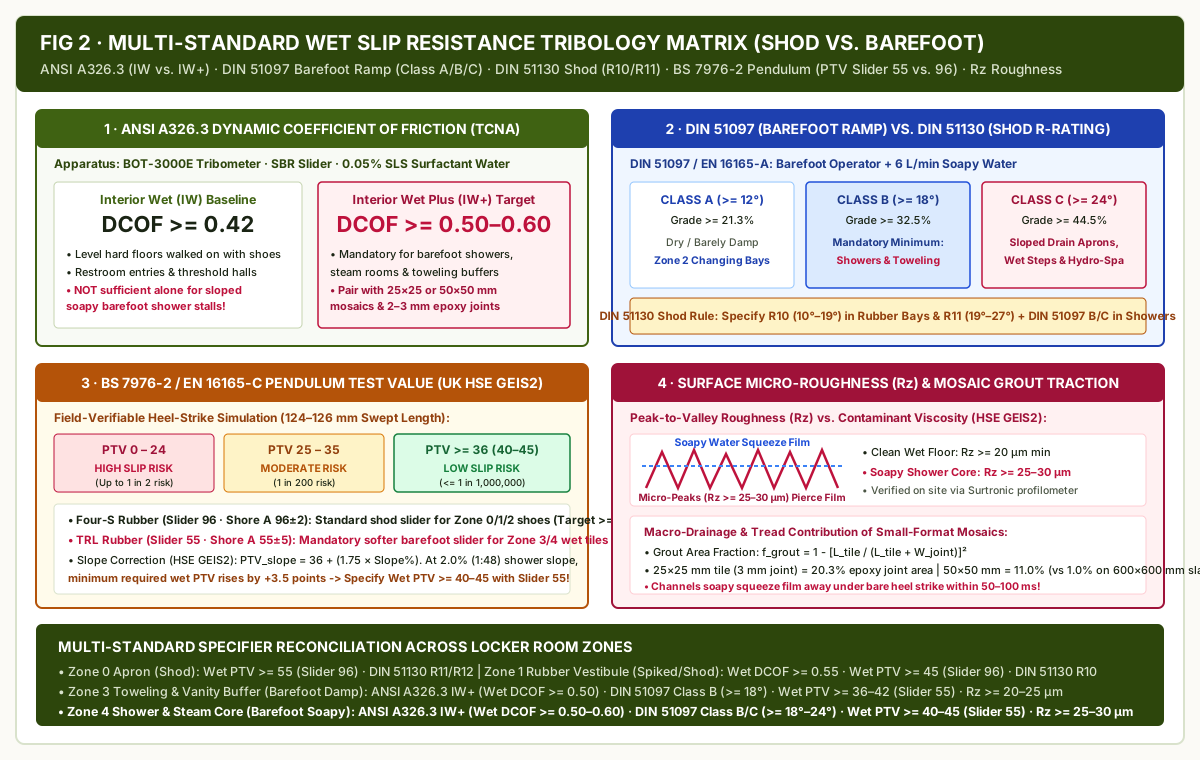
Key takeaway: Never rely on a standard ANSI A326.3 level shod wet DCOF >= 0.42 rating alone for barefoot locker room showers; specify small-format unglazed porcelain mosaics (25 × 25 mm to 50 × 50 mm) carrying the manufacturer’s ANSI A326.3 Interior Wet Plus (IW+) classification (wet DCOF >= 0.50 to 0.60), DIN 51097 / EN 16165 Annex A Class B (>= 18°) or Class C (>= 24°) barefoot ramp certification, BS 7976-2 / UK HSE GEIS2 wet Pendulum PTV >= 40 to 45 (measured with the softer barefoot TRL Slider 55), and a surface peak-to-valley micro-roughness of Rz >= 25 to 30 µm.
Hydrodynamic Squeeze-Film Lubrication Under Soapy Bare Feet
When a barefoot golfer steps out of a shower stall (Zone 4) or walks across the toweling buffer (Zone 3), the contact physics differ fundamentally from a shod pedestrian walking through an entrance lobby. Under hydrodynamic squeeze-film lubrication theory, when a soft bare heel (plantar skin Shore A ~20–30) strikes a wet tile at an impact velocity of 0.8 to 1.2 m/s, the fluid layer trapped between skin and tile must be squeezed out and drained away within 50 to 100 milliseconds to establish solid-to-solid boundary friction.
In a country club shower room, the floor contaminant is not pure rainwater (dynamic viscosity η ≈ 0.89 mPa·s at 25°C). Instead, shower runoff is an emulsion of anionic and amphoteric surfactants (shampoo and body wash), human sebum (triglycerides, wax esters, and squalene), waterproof sunblock, and precipitated calcium/magnesium stearate (soap scum) with an effective boundary viscosity 5 to 20 times higher than water. If a large-format porcelain tile (e.g., 600 × 600 mm) has a smooth or lightly satin finish (Rz < 15 µm) and minimal grout joints, the viscous soap film cannot escape from beneath the plantar skin pad during heel strike—causing the bare foot to hydroplane on a pressurized fluid cushion.
Reconciling the Four International Slip-Resistance Standards (ANSI A326.3, DIN 51097, DIN 51130, and BS 7976-2 PTV)
Architectural tile submittals from North American, European, and UK manufacturers report friction using four different test methods. To prevent dangerous specification gaps, facility engineers must cross-specify all four standards simultaneously:
- North America —
ANSI A326.3(Dynamic Coefficient of Friction — IW vs. IW+):- Published by the Tile Council of North America (TCNA), ANSI A326.3 measures wet Dynamic Coefficient of Friction (
DCOF) using a BOT-3000E digital strain-gauge tribometer pulling a hardSBR(styrene-butadiene rubber) slider across a level tile wetted with0.05%aqueous sodium lauryl sulfate (SLS) surfactant water. - Why
DCOF >= 0.42(Interior Wet — IW) Is Only a Level Shod Baseline: A wet DCOF of0.42is the minimum code baseline for level interior hard floors walked upon with shoes when wet (such as restroom entry corridors or dining thresholds). TCNA explicitly warns in ANSI A326.3 that a raw0.42figure does not account for bare skin biomechanics,1.5% to 2.0%(1:48) shower drainage slopes, or viscous shampoo/oil films. - Mandatory
Interior Wet Plus (IW+)Classification &>= 0.50–0.60Target: Under the revised ANSI A326.3 product-use classifications, locker room wet cores, barefoot communal or individual showers, steam rooms, and pool decks require tiles designated by the manufacturer as Interior Wet Plus (IW+), paired in country club specifications with a tested wetDCOF >= 0.50in Zone 3 toweling/vanity buffers and>= 0.50 to 0.60in Zone 4 sloped shower receptors, plus small-format mosaic grout joint grids (25 × 25 mmto50 × 50 mm).
- Published by the Tile Council of North America (TCNA), ANSI A326.3 measures wet Dynamic Coefficient of Friction (
- Europe —
DIN 51097/DIN EN 16165 Annex A(Barefoot Wet Inclined Ramp Test):- Evaluates true barefoot traction by having two human test operators walk upright forward and backward in bare feet across a tile panel mounted on a hydraulic inclinable ramp flooded continuously with
6 L/minof water containing0.1%soap wetting agent. The ramp inclination increases at1°/suntil the operator slips (critical angle α_barefoot), dividing barefoot wet surfaces into three classes:- Class A (
α >= 12°/21.3%grade /μ_eff >= 0.21): Barefoot dry or lightly damp changing bays (Zone 2dressing areas). - Class B (
α >= 18°/32.5%grade /μ_eff >= 0.325): Mandatory minimum standard for country club shower stall floors (Zone 4), toweling drying buffers (Zone 3), and sauna/steam room floors. - Class C (
α >= 24°/44.5%grade /μ_eff >= 0.445): Recommended for high-gradient linear trench-drain aprons, sloped wet ramps, and submerged hydrotherapy/spa steps.
- Class A (
- Evaluates true barefoot traction by having two human test operators walk upright forward and backward in bare feet across a tile panel mounted on a hydraulic inclinable ramp flooded continuously with
- Europe —
DIN 51130/DIN EN 16165 Annex B(Shod Oil-Wet Ramp Test — R-Ratings):- Tests operators wearing cleated
S1safety boots on a ramp coated inSAE 20motor oil:R9(6°–10°) is restricted to dry rooms;R10(10°–19°) is specified for Zone 1 vulcanized rubber vestibules and dry/damp corridors;R11(19°–27°) is specified for wet shower thresholds, boot-wash rooms, and Zone 0 exterior aprons. - Critical Specifier Guardrail: Never accept a
DIN 51130 R10orR11rating as a substitute forDIN 51097 Class B/Cin a barefoot shower. Industrial silicon-carbideR11/R12tiles designed to bite into hard rubber boot lugs can abrade bare plantar skin while still allowing soapy water to pool between coarse grit islands.
- Tests operators wearing cleated
- UK / International Field Standard —
BS 7976-2/EN 16165 Annex C(UK HSE GEIS2 Pendulum Test Value — PTV):- As established in the UK Health and Safety Executive (HSE) Technical Information Sheet GEIS2 (Assessing the slip resistance of flooring), laboratory ramp tests (
DIN 51097/51130) cannot be brought into an operating golf clubhouse to verify how a floor performs after1, 3, or 5 yearsof wear and soap-scum accumulation. The portable BS 7976-2 Pendulum simulates the exact hydrodynamic physics of a sliding heel strike across a124 to 126 mmswept path on the installed floor using two interchangeable rubber sliders:Four-S Rubber (Slider 96 — Standard Simulated Shoe Sole, Shore A 96±2 / IRHD 96): Used to test shod traffic in Zone 0 aprons, Zone 1 rubber vestibules, and dry/wet corridors.TRL / CEN Rubber (Slider 55 — Soft Elastomer, Shore A 55±5 / IRHD 55): Explicitly mandated by HSE GEIS2 and BS EN 16165 Annex C to simulate bare feet in wet shower stalls, toweling buffers, and pool surrounds.
- HSE Slip Potential Classifications (
Wet PTV):PTV 0–24= High Slip Potential (up to 1 in 2to1 in 20slip risk);PTV 25–35= Moderate Slip Potential (1 in 200risk);PTV >= 36= Low Slip Potential (<= 1 in 1,000,000statistical risk). - Slope Correction (
+3 to +4 PTVon1.5%–2.0%Shower Falls) & Surface Micro-Roughness (Rz >= 25–30 µm): Per HSE GEIS2, every1°(1.75%) of floor drainage slope requires adding1.75 × Slope%(+3.0 to +3.6 PTV pointsat a1.75% to 2.08%[1:48] shower pitch) to the36 PTVflat-floor baseline—makingWet PTV >= 40 to 45(with TRL Slider 55) the mandatory field acceptance target for sloped shower stalls, backed by a stylus profilometer (Surtronic Duo) reading ofRz >= 20 µmin clean wet zones andRz >= 25 to 30 µmin soapy shower receptors.
- As established in the UK Health and Safety Executive (HSE) Technical Information Sheet GEIS2 (Assessing the slip resistance of flooring), laboratory ramp tests (
Slope-Corrected Minimum Wet Pendulum Value (PTV_min_slope) = 36 + (100 * tan(theta_rad)) = 36 + Slope_percent
 HSE GEIS2 Conservative Slope Allowance (PTV_target_slope) = 36 + (1.75 * Slope_percent)
Mosaic Grout Joint Area Fraction (f_grout) = 1 - ((L_tile_mm / (L_tile_mm + W_joint_mm)) ^ 2)
Composite Mosaic Wet Traction Index (DCOF_composite) = ((1 - f_grout) * DCOF_tile) + (f_grout * DCOF_epoxy_joint) + Delta_DCOF_edge
Worked Barefoot Slope-Correction & Mosaic Grout-Joint Traction Calculation
Why do 25 × 25 mm (1 × 1 in.) or 50 × 50 mm (2 × 2 in.) unglazed porcelain mosaics with 2.5 to 3.0 mm (1/8 in.) ANSI A118.3 quartz-epoxy grout joints dramatically outperform 600 × 600 mm (24 × 24 in.) large-format porcelain slabs on a sloped shower pan?
- Step 1 — Slope-Corrected Pendulum Target (
PTV_target_slope) on anADA §608.7/IPC §421Shower Receptor:- As established in locker room design: negative-pressure ventilation, wet-zone separation, benches, and plinth lockers, accessible country club shower stalls pitch at
2.0%(1/4 in./ft/1:50, just under the1:48[2.08%]ADA §608.7ceiling) toward aType 316stainless steel linear trench drain. - Applying the HSE GEIS2 slope penalty (
+1.75 PTV per 1% slopefor conservative barefoot safety): PTV_target_slope = 36 + (1.75 * 2.0) = 39.5 -> Specify Wet PTV >= 40 to 45 (TRL Slider 55).
- As established in locker room design: negative-pressure ventilation, wet-zone separation, benches, and plinth lockers, accessible country club shower stalls pitch at
- Step 2 — Grout-Joint Area Fraction (
f_grout) & Drainage Channel Density per Foot-Print:- Compare three porcelain tile formats set with a
3.0 mm(1/8 in.)ANSI A118.3quartz-filled epoxy joint under an adult bare heel/foot print (260 mm × 100 mm = 26,000 mm²):- Large-Format
600 × 600 mm(24 × 24 in.) Tile:f_grout = 1 - (600 / 603)^2 = 0.0099 (0.99% grout area). A bare foot striking the center of a600 mmslab contacts zero grout joints (0 mmof macro-drainage channel), forcing the entire100 mmheel width to squeeze viscous soap film laterally across flat ceramic. - Medium-Format
150 × 150 mm(6 × 6 in.) Tile (Zone 3 Toweling Buffer):f_grout = 1 - (150 / 153)^2 = 0.0388 (3.88% grout area), engaging1 to 2joint edges per foot strike. - Small-Format
50 × 50 mm(2 × 2 in.) Shower Mosaic (Zone 4):f_grout = 1 - (50 / 53)^2 = 0.1100 (11.0% grout area). Every bare foot strike bridges5 longitudinal × 2 transverse = 7 intersecting 3 mm epoxy grout channels, reducing maximum hydrodynamic squeeze-film escape distance from50 mmto<= 25 mm(cutting fluid squeeze-out time by 75%). - Micro-Format
25 × 25 mm(1 × 1 in.) Shower Mosaic (Zone 4 High-Risk / Steam Core):f_grout = 1 - (25 / 28)^2 = 0.2028 (20.3% grout area), engaging10 × 4 = 14 intersecting grout channelsunder a single bare foot and shortening fluid escape distance to<= 12.5 mm.
- Large-Format
- Compare three porcelain tile formats set with a
- Step 3 — Composite Wet DCOF Contribution (
DCOF_composite):- Given an unglazed porcelain body with
DCOF_tile = 0.50(Rz = 26 µm), a quartz-aggregateANSI A118.3epoxy joint withDCOF_epoxy_joint = 0.65, and a macro-tread edge relief bonus (Delta_DCOF_edge = +0.04for50 × 50 mmand+0.07for25 × 25 mmmosaics at a0.4 mmconcave joint profile): 50 × 50 mm Mosaic DCOF_composite = (0.89 * 0.50) + (0.11 * 0.65) + 0.04 = 0.445 + 0.0715 + 0.04 = 0.557(Passes >= 0.50–0.60 IW+ target).25 × 25 mm Mosaic DCOF_composite = (0.797 * 0.50) + (0.203 * 0.65) + 0.07 = 0.3985 + 0.1320 + 0.07 = 0.601(Exceeds 0.60 IW+ target).
- Given an unglazed porcelain body with
| Tribology Test Standard & Authority | Test Apparatus & Wetting Contaminant | Zone 1 & 2 Target (Shod / Dry Corridor & Rubber) | Zone 3 Target (Barefoot Damp Toweling & Vanity Buffer) | Zone 4 Target (Barefoot Soapy Shower Stall & Steam Core) |
|---|---|---|---|---|
| ANSI A326.3 (TCNA / North America) | BOT-3000E digital tribometer (SBR rubber slider) in 0.05% SLS surfactant solution on level surface |
Wet DCOF >= 0.42 (Interior Wet — IW baseline; >= 0.55 on Zone 1 rubber) |
Interior Wet Plus (IW+) classification; Wet DCOF >= 0.50 |
Interior Wet Plus (IW+) + Wet DCOF >= 0.50–0.60 + 25×25 or 50×50 mm mosaics |
| DIN 51097 / EN 16165 Annex A (Barefoot Wet Ramp) | Human barefoot operators walking on inclinable ramp flooded with 6 L/min of 0.1% soapy water |
Class A (Critical slip angle >= 12° / 21.3% grade) |
Class B (Critical slip angle >= 18° / 32.5% grade) |
Class B (>= 18°) minimum; Class C (>= 24° / 44.5% grade) on sloped drain aprons & steps |
| DIN 51130 / EN 16165 Annex B (Shod Ramp) | Human operator in cleated S1 boots walking on SAE 20 motor-oil ramp |
R10 (10°–19° slip angle) in Zone 1 rubber; R11 (19°–27°) at Zone 0 apron |
R10 / R11 (10°–27°, paired with DIN 51097 Class B) |
R11 (19°–27°, must be paired with DIN 51097 B/C so grit never abrades bare feet) |
| BS 7976-2 / EN 16165 Annex C (UK HSE GEIS2 Pendulum) | Portable swinging heel-strike pendulum (Slider 96 shod vs. Slider 55 barefoot) on actual floor |
Wet PTV >= 36 (>= 45 on Zone 1 rubber) using Four-S Slider 96 |
Wet PTV >= 36–42 using both TRL Slider 55 (barefoot) & Slider 96 |
Wet PTV >= 40–45 using TRL Slider 55 (includes +3.5 PTV allowance for 2% slope) |
HSE Surface Micro-Roughness (Rz) |
Portable stylus profilometer (Surtronic Duo) measuring 5-spot mean peak-to-valley height (µm) |
Rz >= 15 µm (dry interior) / >= 20 µm (wet vestibule entry) |
Rz >= 20 to 25 µm across toweling & vanity tile |
Rz >= 25 to 30 µm (peaks must pierce viscous shampoo & sebum squeeze film) |
3. Subfloor Waterproofing (TCNA B421/B422 & ANSI A118.10), ANSI A118.3 Epoxy Grout, and ADA §302/§303 Zone Transitions
Key takeaway: Detail wet shower and toweling cores to TCNA Handbook Methods B421 or B422 over a continuous ANSI A118.10 load-bearing bonded waterproof membrane sloped at 1.5% to 2.0% (max 1:48 per ADA §608.7) and flood-tested for 24 hours, grout all wet-zone porcelain mosaics with ANSI A118.3 100% solids chemical-resistant epoxy grout (< 0.1%–0.5% water absorption in 2 to 3 mm joints), and depress the wet-core concrete slab by 6 to 8 mm (1/4 to 5/16 in.) to achieve flush <= 1/4 in. (6.4 mm) ADA §303 transitions across a Type 316 stainless steel capillary-break threshold.
Subfloor Waterproofing Assemblies: TCNA B421 / B422 and ANSI A118.10
As documented in the TCNA Handbook Showers FAQ (Methods B421 and B422) and TCNA ANSI Installation Standards, ceramic and porcelain tile assemblies are water-shedding wear surfaces, not waterproof barriers. In a country club shower core discharging 40 to 140+ hot showers per day, water migrates beneath the tile plane via microscopic thermal expansion fissures (TCNA EJ171 perimeter movement joints) and drain flanges. If the subfloor lacks a positively sloped, bonded membrane, water saturates the mortar bed, leaches free calcium hydroxide (Ca(OH)2) to the surface as crusty white efflorescence, and rots adjacent dry-zone carpet adhesives.
Specify a five-layer wet-core subfloor assembly across 100% of Zone 4 (Showers, Steam Rooms, and Restrooms) and Zone 3 (Toweling & Grooming Vanity Buffer):
- Depressed Structural Slab & Pre-Sloped Mortar Bed (
1.5% to 2.0%/max 1:48perADA §608.7): Depress the structural concrete slab in the wet core to accommodate the mortar bed and tile buildup, and form a laser-screeded pre-slope at1.5% to 2.0%(3/16 to 1/4 in. per foot, strictly<= 2.08%[1:48] insideADA §608.7accessible shower stalls) pitching in a single plane toward aType 316stainless steel linear trench drain (IPC §421.3). - Load-Bearing Bonded Waterproof Membrane (
ANSI A118.10&ANSI A118.12): Under TCNA Method B422 (preferred over traditionalB421buried weeping pans becauseB422keeps the underlying mortar bed dry), bond a continuous20 to 30 mil(0.50 to 0.75 mm) sheet polyethylene fleece membrane or two-coat liquid elastomeric membrane certified to ANSI A118.10 (Load-Bearing, Bonded, Waterproof Membranes for Thin-Set Ceramic Tile) and ANSI A118.12 (Crack Isolation Membranes) directly to the top of the sloped mortar bed. Turn the membrane continuously up all perimeter walls and100 to 150 mmlocker plinth curbs a minimum of6.0 in.(150 mm) above the finished floor (and full height to 84 in. AFF on shower compartment walls), and clamp or thermally weld it into theType 316stainless integrated bonding-flange drain. - Mandatory 24-Hour Hydrostatic Flood Test (
IPC §421.5.2): Prior to setting tile, plug the drain waste pipe below the bonding flange, fill the entire waterproofed shower and toweling pan with2.0 in.(51 mm) minimum depth of water, mark the waterline with a laser or micrometer gauge, and verify0.0 mmwater drop over24 hours. - 95%+ Contact Polymer-Modified Thin-Set Mortar (
ANSI A118.4 / A118.15&ANSI A108.5): Bed impervious unglazed porcelain mosaics (ASTM C373 water absorption <= 0.5%) in a high-performance polymer-modified thin-set mortar (ANSI A118.15 or ANSI A118.4) troweled in one uniform direction (never spot-bonded) to achieve>= 95%wet mortar contact coverage (100%along all tile edges and corners perANSI A108.5), eliminating hollow sub-tile voids where stagnant water can collect or crack tiles under point loads. - Perimeter & Threshold Movement Joints (
TCNA EJ171): Leave a3.0 to 6.0 mm(1/8 to 1/4 in.) soft expansion joint packed with closed-cell backer rod and sealed with 100% sanitary mildew-resistant neutral-cure silicone (ASTM C920 Class 25,Shore A 25–30) at all floor-to-wall coves, column perimeters, drain flanges, and threshold transitions (never pack perimeter coves with rigid grout).
Why ANSI A118.3 100% Solids Epoxy Grout Is Mandatory Over Cementitious Grout
Specifying Portland cement grout (ANSI A118.6 standard sanded/unsanded or ANSI A118.7 polymer-modified cement grout) in a country club shower core guarantees hygiene and structural failure within 6 to 12 months:
- The Porosity & Biofilm Problem: Cured cementitious grouts exhibit
3% to 10%water absorption by weight and a capillary network of alkaline micro-pores. In an80°F(26.7°C) humid shower stall, those pores wick up human sweat, desquamated skin keratin, urea, and fatty-acid soap scum—creating an ideal nutrient bed inside the grout joint for Serratia marcescens (pink slime biofilm), Pseudomonas aeruginosa, and Aspergillus / Cladosporium black mold. - The Acid-Etching & Efflorescence Problem: Portland cement binds quartz sand together with calcium silicate hydrate (
C-S-H) and15% to 20%free soluble calcium hydroxide (Ca(OH)2). Whenever housekeeping applies an acidic descaler (pH 2.0 to 3.5) to remove hard-water limescale and calcium stearate soap scum from the tiles, the acid reacts directly with the calcium binder inANSI A118.6 / A118.7cement grout—dissolving the joint surface, shedding gritty sand, undercutting the25 × 25 mmmosaic edges, and bleeding white carbonate efflorescence across dark porcelain tiles.
To eliminate grout degradation permanently, mandate ANSI A118.3 (100% Solids Chemical-Resistant, Water-Cleanable Tile-Setting and -Grouting Epoxy) across 100% of Zone 3 and Zone 4 floor and wall joints:
- Three-Part 100% Solids Thermoset Matrix: Formulated from Part A (
bisphenol-A/F epichlorohydrin resin), Part B (modified polyamine hardener), and Part C (color-coated quartz microspheres, optionally compounded with silver-ion antimicrobial additives tested toISO 22196), containing zero volatile solvents or portland cement. - Impervious
< 0.1% to 0.5%Water Absorption: WhereasANSI A118.6cement grout absorbs5% to 10%water, ANSI A118.3 caps water absorption at<= 0.5%(with leading commercial 100% solids epoxies testing at< 0.05% to 0.10%). Sweat, urea, and bacteria remain strictly on the surface where daily scrubbing washes them down the drain. - High Mechanical & Chemical Strength (
ASTM C267): Cures to a 7-day compressive strength of>= 3,500 to 8,500 psi(24 to 58 MPa), tensile strength>= 1,000 psi(6.9 MPa), and flexural bond strength>= 1,000 psi, locking small25 × 25 mmand50 × 50 mmmosaics against thermal shock (steam rooms up to 120°F–130°F) and high-pressure rotary scrubbing while resisting continuous chemical exposure (ASTM C267) across the fullpH 1.5 to 12.5cleaning spectrum with zero efflorescence and zero color fade.
| Grout Performance Parameter | ANSI A118.3 100% Solids Epoxy Grout (Mandatory Wet-Core Standard) | ANSI A118.7 Polymer-Modified Cement Grout (Dry Wall Only) | ANSI A118.6 Standard Portland Cement Grout (Prohibited) |
|---|---|---|---|
| Binder Chemistry | 100% solids thermoset bisphenol epoxy resin + polyamine hardener + coated quartz | Hydraulic Portland cement + redispersible latex polymer + silica sand | Ordinary Portland cement + calcium carbonate / silica aggregate |
| Water Absorption at Immersion | < 0.1% to 0.5% (ANSI A118.3 max limit <= 0.5%; virtually non-porous) |
3.0% to 5.0% (requires periodic topical penetrating sealers) |
5.0% to 10.0%+ (acts as a capillary sponge in wet stalls) |
| 7-Day Compressive Strength | >= 3,500 to 8,500 psi (24.1 to 58.6 MPa) |
~3,000 to 3,500 psi (20.7 to 24.1 MPa) |
~2,000 to 3,000 psi (13.8 to 20.7 MPa) |
Acid Descaler Resistance (pH 2.0–3.5) |
Excellent (ASTM C267 pass): Immune to weekly phosphoric, sulfamic & citric acid washes |
Poor: Acid dissolves calcium binder, roughens joints, and strips pigment | Fails Rapidly: Acid fizzes and erodes cement matrix within weeks |
| Efflorescence & Biofilm Resistance | Zero free lime (0% efflorescence); blocks Serratia pink slime & black mold root penetration |
Moderate risk of calcium carbonate bloom and surface mildew staining | High efflorescence crusting and deep internal mold colonization |
ADA §302 / §303 Flush Floor Transitions and Sub-Surface Capillary Breaks
Where Zone 1 vulcanized rubber (8 to 12 mm), Zone 2 Nylon 6,6 carpet tiles (7 to 9 mm), and Zone 3/4 porcelain tile + thin-set + waterproof membrane (12 to 16 mm) meet at doorway thresholds, specifications must comply with U.S. Access Board ADA Chapter 4 (§302 Floor Surfaces and §303 Changes in Level):
- Vertical & Beveled Change-in-Level Limits (
ADA §303.2&§303.3): Changes in level along any accessible route inside the locker room must not exceed1/4 in.(6.4 mm) vertical (ADA §303.2), or1/4 in. to 1/2 in.(6.4 to 13 mm) beveled at a maximum slope of1:2(50%) (ADA §303.3). Exposed carpet tile edges at transitions must be fastened to the subfloor and fitted with transition trim meeting these exact bevel limits (ADA §302.2). - Subfloor Slab Depression (
6 to 8 mmRecess for Zero-Lippage Transitions): Do not lay14 mmof wet tile and thin-set on top of a flat slab and bridge down to8 mmcarpet tile with a surface-applied reducer strip—bare feet trip on raised metal strips, and squeegee blades catch on the lip. Detail a6 to 8 mm(1/4 to 5/16 in.) structural slab depression at the Zone 2 / Zone 3 doorway line so the finished top surface of the porcelain tile, solid-surface/stainless threshold saddle, and Nylon 6,6 carpet tile sit within<= 1.5 mm(1/16 in.) of true flush. - Sub-Surface Capillary Break Dam (
Stopping Lateral Mortar Wicking): Even when surface water is held back by a1.0% to 1.5%pitch in the Zone 3 toweling buffer, moisture inside the thin-set mortar bed beneath the porcelain tile will migrate horizontally by capillary action across a doorway if the mortar contacts the carpet tile backing. Install an L-shapedType 316stainless steel threshold profile anchored into a verticalANSI A118.10waterproof membrane turn-up extending from the structural concrete slab all the way to the finished tile surface, sealed on the dry carpet side withASTM C920neutral-cure silicone.
4. Daily Alkaline vs. Weekly Acidic Scrubbing Protocols: Preventing Micro-Roughness Blinding in Wet & Dry Zones
Key takeaway: Prohibit string mops, neutral-only pine/quaternary cleaners, and acrylic floor waxes in locker room wet cores; preserve Rz >= 25 to 30 µm porcelain micro-roughness and PTV >= 40 barefoot traction by executing a daily pH 9.5 to 11.5 alkaline surfactant degreasing scrub (saponifying body sebum and sunblock) paired with a weekly pH 2.0 to 3.5 buffered acidic descaling scrub (dissolving insoluble calcium stearate soap scum and hard-water carbonate scale), applied with an 8 to 10 minute wet dwell time, 400 to 650 RPM counter-rotating cylindrical brushes, and immediate wet-vacuum extraction.
The 90-Day Friction Collapse: How String Mopping Blinds Rz = 28 µm Safety Tiles
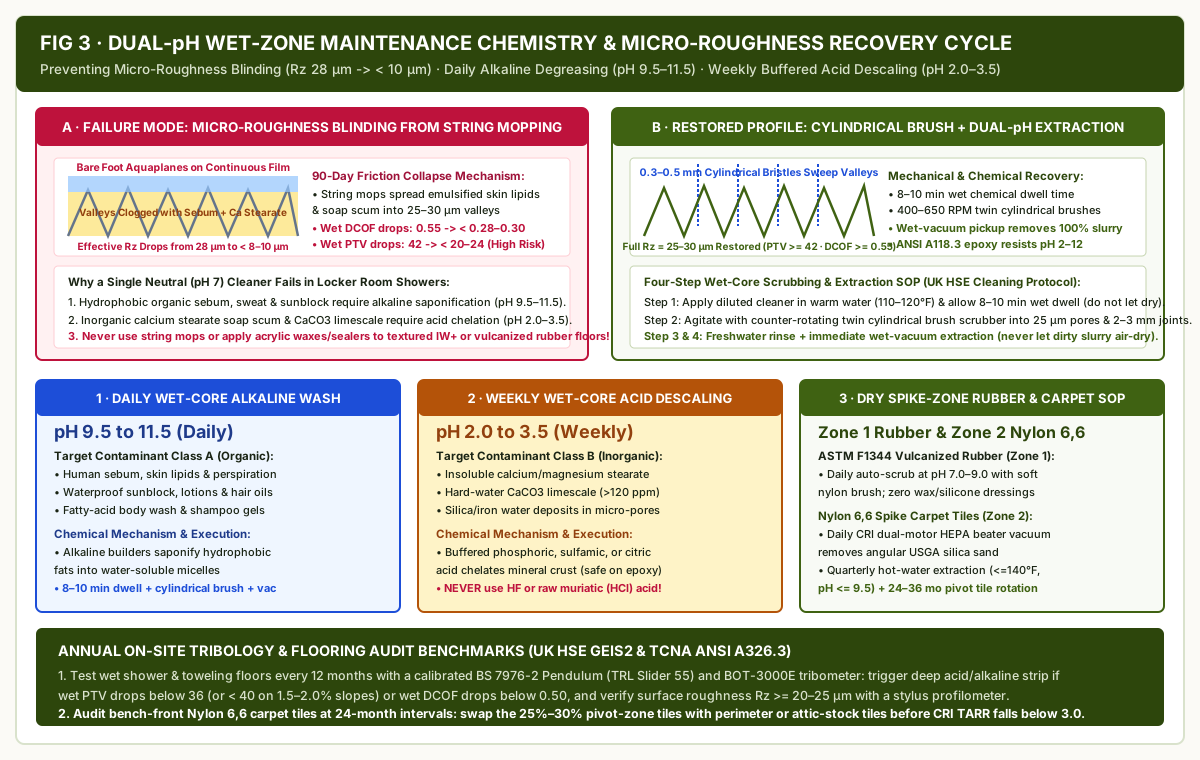
As documented in the UK Health and Safety Executive (HSE) Slips and Trips surface maintenance guidance, the most frequent cause of barefoot slip accidents in commercial changing rooms is micro-roughness blinding (also termed pore clogging). A club invests in an ANSI A326.3 IW+ / DIN 51097 Class B porcelain mosaic with a factory peak-to-valley micro-roughness of Rz = 28 µm and an initial wet Pendulum value of PTV = 44 (Slider 55). Yet within 60 to 90 days of opening, members report the shower floor feels like ice.
Why does traction collapse? Because housekeeping staff clean the wet core with a cotton or microfiber string mop dipped in a bucket of neutral (pH 7.0) pine or quaternary ammonium cleaner:
- Emulsification Without Extraction: A string mop glides across the top peaks of a textured
Rz 28 µmtile without reaching into the20 to 30 µmmicroscopic valleys or the2 to 3 mmrecessed epoxy grout joints. Instead of lifting contaminants off the floor, the mop smears warm body sebum, skin lipids, and fatty-acid soap across the tile surface as a uniform liquid film. - Precipitation of Insoluble Calcium Stearate & Carbonate Scale: As the thin mop-water film evaporates between shower waves, calcium (
Ca²⁺) and magnesium (Mg²⁺) ions in the potable water supply (especially in hard-water regions > 120 ppm CaCO3) react with sodium/potassium stearate from bar soaps and body washes to precipitate insoluble calcium stearate (Ca(C18H35O2)2— metallic soap scum) cemented together by calcium carbonate (CaCO3) limescale. - Loss of Peak-to-Valley Penetration (
Rz < 10 µm): Layer by layer, this waxy mineral-lipid composite fills the28 µmmicro-valleys of the porcelain tile until effective exposed peak height drops belowRz = 8 to 10 µm. When a wet bare heel strikes the blinded tile, the muted peaks can no longer pierce the soapy squeeze film—dropping wetDCOFfrom0.55to< 0.28–0.30and wet PendulumPTVfrom44to< 20–24(High Slip Potential).
Why Two Contaminant Classes Require Two Opposite pH Chemistries (pH 9.5–11.5 vs. pH 2.0–3.5)
No single neutral (pH 7) detergent can dissolve both hydrophobic human body oils and inorganic mineral scale. Per HSE cleaning chemistry principles and TCNA porcelain maintenance protocols, wet-core housekeeping must alternate two targeted chemical regimens:
- Daily Regimen — Alkaline Surfactant Degreasing (
pH 9.5 to 11.5) for Organic Lipids (Contaminant Class A):- Target Soils: Human sebum (
triglycerides, free fatty acids, squalene), eccrine/apocrine perspiration, waterproof titanium/zinc sunblock, hair conditioners (dimethicone/quaternary silicones), and body lotions. - Chemical Action: Diluted in warm potable water (
110°F to 120°F/43°C to 49°C), alkaline builders (sodium metasilicate, potassium carbonate, or alkanolaminesatpH 9.5 to 11.5) saponify esterified fats into water-soluble soap micelles while non-ionic and anionic surfactants emulsify non-saponifiable oils so mechanical bristles can lift them out of the25 to 30 µmporcelain pores.
- Target Soils: Human sebum (
- Weekly Regimen — Buffered Acidic Descaling (
pH 2.0 to 3.5) for Inorganic Scale & Soap Scum (Contaminant Class B):- Target Soils: Insoluble calcium stearate and magnesium stearate (
soap scum), hard-water calcium carbonate (CaCO3) and magnesium carbonate (MgCO3) limescale, silica water spots, and ferric iron staining. - Chemical Action: Alkaline cleaners cannot dissolve inorganic calcium carbonate or metallic stearate salts (
which are already alkaline/neutral precipitates). Once per week (or twice weekly in very hard water> 180 ppm CaCO3), scrub the Zone 3 and Zone 4 porcelain tiles with a buffered organic/inorganic acid descaler (pH 2.0 to 3.5, formulated with phosphoric acid, sulfamic acid, or citric acid). The low-pH chelation converts insoluble calcium stearate andCaCO3crust into soluble calcium ions that flush cleanly into the wet vacuum, restoring the virginRz = 25 to 30 µmporcelain peak profile. - Critical Acid Safety Guardrail: Because the wet core is grouted with ANSI A118.3
100%solids epoxy grout (rather than porous cement), weeklypH 2.0 to 3.5buffered acid washes cause zero grout etching. However, never use hydrofluoric acid (HF), ammonium bifluoride (ABF), or uninhibited muriatic/hydrochloric acid (HCl)—hydrofluoric compounds chemically etch the silicon dioxide (SiO2) matrix of porcelain tile (destroying factory micro-texture), while raw chloride acids pitType 316stainless steel linear trench drains.
- Target Soils: Insoluble calcium stearate and magnesium stearate (
Four-Step Mechanical Cylindrical-Brush Scrubbing & Extraction SOP
To ensure cleaning solutions actually empty the microscopic valleys rather than redistributing dirt, enforce the Four-Step Wet-Core Scrubbing & Wet-Vacuum Extraction Standard Operating Procedure:
- Step 1 — Low-Pressure Chemical Application &
8 to 10 MinuteWet Dwell Time: Apply the diluted daily alkaline degreaser (pH 9.5–11.5) or weekly buffered acid descaler (pH 2.0–3.5) generously across the shower and toweling tile floor (110°F–120°Fwater temperature) and let it dwell wet on the surface for8 to 10 minutes(misting lightly if needed so the solution never dries before scrubbing). Chemical dwell time does70%of the work by breaking the adhesive bond between the sebum/stearate film and the silica pores. - Step 2 — Counter-Rotating Cylindrical Brush Agitation (
400–650 RPM): Agitate the floor using a compact walk-behind or cordless counter-rotating twin-cylindrical brush scrubber fitted with0.30 to 0.50 mmdiameter polypropylene or nylon bristles (never use a flat rotary floor pad or string mop). Unlike flat disc pads that ride over the tops of structuredIW+tiles, high-speed cylindrical bristles flick downward into both the25 to 30 µmmicro-roughness valleys and the2 to 3 mmANSI A118.3epoxy grout joints. - Step 3 — Potable Freshwater Rinse & Immediate Wet-Vacuum Extraction: Rinse the scrubbed floor with clean freshwater and vacuum up
100%of the suspended emulsified slurry immediately using the machine’s rear parabolic squeegee vacuum head (or squeegee directly into theType 316stainless linear trench drain followed by a clean water flush). Never allow dirty detergent water to evaporate on the tile. - Step 4 — Dry-Zone (
Zone 1Rubber &Zone 2Carpet Tile) Maintenance Separation: Keep wet-core acid/alkaline slurries strictly out of dry zones (protected by the ADA §303 capillary-break threshold):- Zone 1 Vulcanized Rubber (
ASTM F1344): Auto-scrub daily with apH 7.0 to 9.0neutral-to-mild-alkaline cleaner and a soft nylon cylindrical brush. Never apply acrylic floor polish, polymer sealers, mop-and-shine waxes, or silicone tire dressings to vulcanized rubber; topical coatings fill the micro-textured EPDM wear layer, peel under540 psigolf spikes, and drop wetDCOFbelow0.35. - Zone 2 Solution-Dyed Nylon 6,6 Carpet Tiles (
CRI TARR >= 3.5): Vacuum daily (and between morning/afternoon tournament shotgun waves) using a CRI Seal of Approval Gold/Silver dual-motor upright vacuum with a rotating beater brush andHEPAfiltration to extract angularMohs 7.0USGA silica sand before spikes grind it into the tuft base. Perform low-moisture encapsulation cleaning monthly and hot-water extraction (water temperature <= 140°F[60°C], detergentpH <= 9.5, zero optical brighteners or cationic softeners) quarterly, drying within<= 4 to 6 hoursunder the room’s8 to 10 ACHdehumidified HVAC system (50%–55% RH).
- Zone 1 Vulcanized Rubber (
| Flooring Zone & Material | Contaminant Profile | Cleaning Frequency & Chemistry (pH) | Mechanical Agitation & Extraction Tool | Prohibited Chemicals & Practices |
|---|---|---|---|---|
| Zone 3 & 4: Unglazed Porcelain Mosaics + Epoxy Grout (Daily Routine) | Human sebum, skin lipids, sweat, sunblock, and shampoo surfactant film | Daily: Alkaline surfactant degreaser at pH 9.5 to 11.5 in 110–120°F water (8–10 min dwell) |
Counter-rotating twin cylindrical brush scrubber (400–650 RPM, 0.3–0.5 mm nylon bristles) + wet-vacuum pickup |
No string mops; no neutral-only oily pine soaps; never allow dirty wash slurry to air-dry on tile |
| Zone 3 & 4: Unglazed Porcelain Mosaics + Epoxy Grout (Weekly Descale) | Insoluble calcium/magnesium stearate soap scum & hard-water CaCO3 limescale |
Weekly (or Bi-Weekly): Buffered phosphoric, sulfamic, or citric acid descaler at pH 2.0 to 3.5 (8–10 min dwell) |
Cylindrical brush scrubbing into 25–30 µm pores & 2–3 mm epoxy joints + freshwater rinse & wet-vac |
Never use hydrofluoric acid (HF), ammonium bifluoride, or raw muriatic acid (HCl); no topical tile sealers |
Zone 1: ASTM F1344 Vulcanized Virgin/EPDM Rubber (8–12 mm) |
Tracked turf mud, USGA silica sand, grass chlorophyll, and shoe polish | Daily: Neutral to mild-alkaline elastomeric cleaner at pH 7.0 to 9.0 |
Auto-scrubber with soft nylon cylindrical brush or red/blue microfiber scrubber pad + vacuum squeegee | Never apply acrylic floor wax, urethane finish, silicone dressing, or solvent degreasers (pH > 11) |
Zone 2: Solution-Dyed Nylon 6,6 Spike Carpet Tiles (500 × 500 mm) |
Dry angular USGA silica sand (0.25–1.0 mm), turf iron/fertilizer, and beverage spills |
Daily: Dry HEPA beater vacuuming; Quarterly: Hot-water extraction at pH 7.0 to 9.5 (<= 140°F); 24–36 mo: Rotate 25%–30% pivot tiles |
CRI Seal of Approval dual-motor upright beater vacuum + portable/truck-mount extractor (<= 4–6 hr dry time) |
No rotary bonnet buffing (distorts high-twist loop tips); no cationic fabric softeners or optical brighteners |
| Zone 0: Commercial Outdoor Flooring & Vestibule Grid | Coarse mud clods, bunker sand, grass clippings, and standing rainwater | Daily: High-pressure water flush of exterior EPDM tiles/grating pan; Weekly: Vacuum & extract wiper rails | Pressure hose (`<= 1,200 psi`) + commercial wet/dry vacuum for recessed aluminum rail pan & sediment trap | Never let aluminum rail pan fill with sand above bottom of rail (blocks drainage and rocks grate bars) |
5. On-Site Flooring Commissioning & Annual Slip-Audit Checklist
Key takeaway: Commission new locker room floor installations and audit existing facilities every 12 months using six quantitative field tests—ASTM F2170 in-situ slab relative humidity probes (<= 80%–85% RH), a 24-hour hydrostatic flood test (2 in. depth, 0 mm drop), a portable BS 7976-2 Pendulum tester with TRL Slider 55 (wet PTV >= 40 in showers) and Four-S Slider 96 (wet PTV >= 45 on rubber), a BOT-3000E tribometer (wet DCOF >= 0.50–0.60), a Surtronic stylus profilometer (Rz >= 25–30 µm), and an ADA §302/§303 transition gauge (<= 1/4 in.).
When signing off on architectural submittals or conducting an annual pre-tournament safety walk-through alongside clubhouse walls and floors where mud meets the building and changing rooms: benches, hooks and water on the tile, verify and log the following eight benchmarks:
- Concrete Subfloor Moisture & pH Verification (
ASTM F2170): Before installing Zone 1 vulcanized rubber or Zone 2 Nylon 6,6 carpet tiles, drill and equilibrate ASTM F2170 in-situ relative humidity probes at40%slab depth (3 probes for the first 1,000 sq ft + 1 per additional 1,000 sq ft). Confirm<= 80% to 85% RHand surfacepH 7.0 to 9.0; if RH exceeds85%, require a two-coatASTM F3010100% solids epoxy vapor-mitigation barrier before applying releasable acrylic PSA or polyurethane rubber adhesive. - Golf Spike Carpet Tile & Attic Stock Verification (
Zone 2): Inspect mill certificates and physical samples to confirm100%solution-dyed Nylon 6,6 fiber,32 to 48 oz/yd²(1,085–1,625 g/m²) face weight,>= 6,500 to 8,500 oz/yd³volumetric density (ASTM D5848),<= 0.31 in.(8.0 mm) pile height (strictly <= 1/2 in.[13 mm] perADA §302.2),CRI TARR >= 3.5(Severe Traffic) + dynamic golf-spike drum certification, fiberglass-reinforced impervious cushion backing, and on-site delivery of10% to 15%same-dye-lot attic stock for24-to-36-monthbench-front pivot rotation. - Vulcanized Rubber Durometer & Porosity Verification (
Zone 1&Zone 0): Confirm8 to 12 mm(3/8 to 1/2 in.) ASTM F1344 Class I/II vulcanized virgin/EPDM rubber (< 0.05%water absorption—reject porous recycled SBR crumb rubber), verify>= 85 Shore Atop wear layer hardness over a60 to 65 Shore Acushion base (ASTM D2240), and confirm10 to 15 linear feet(3.0 to 4.5 m) of Zone 0 commercial outdoor flooring and recessed aluminum scraper-wiper grating (<= 1/2 in.openings perADA §302.3). - 24-Hour Hydrostatic Membrane Flood Test & Drainage Slope (
TCNA B421/B422&IPC §421.5.2): Verify with a digital inclinometer that the Zone 4 shower receptor pitches at1.5% to 2.0%(3/16 to 1/4 in./ft, strictly<= 2.08%[1:48] perADA §608.7) and the Zone 3 toweling buffer pitches at1.0% to 1.5%towardType 316stainless steel linear trench drains. Witness and sign the 24-hour flood test (>= 2.0 in.[51 mm] water depth with0.0 mmloss) on the ANSI A118.10 bonded waterproof membrane (turned up walls and locker plinth curbs >= 6.0 in.) prior to tile setting. - Small-Format Porcelain Mosaic &
ANSI A118.3Epoxy Grout Inspection (Zone 3&Zone 4): Confirm>= 95%polymer-modified thin-set coverage (ANSI A108.5) beneath25 × 25 mm(1 × 1 in.) or50 × 50 mm(2 × 2 in.) unglazed porcelain mosaics (ASTM C373 <= 0.5%absorption), and verify that all2.0 to 3.0 mmfloor and wall joints are grouted with ANSI A118.3100%solids chemical-resistant epoxy grout (reject any ANSI A118.6 or A118.7 cementitious grout in wet zones). - Flush
ADA §303Doorway Transitions & Capillary Break: Place a straightedge and feeler gauge across every rubber-to-carpet and carpet-to-tile threshold to verify<= 1/4 in.(6.4 mm) vertical change in level (or1/4 to 1/2 in.beveled at1:2max perADA §303.3), confirming that the wet-core concrete slab is recessed6 to 8 mmand isolated by aType 316stainless steel andANSI A118.10vertical capillary dam. - On-Site Pendulum (
BS 7976-2), Tribometer (ANSI A326.3) & Roughness (Rz) Audit: At commissioning—and every 12 months thereafter prior to peak tournament season—test the wet shower and toweling floors on site:- BS 7976-2 Pendulum (
TRL Slider 55Barefoot): ConfirmWet PTV >= 40 to 45on sloped Zone 4 shower receptors andWet PTV >= 36 to 42on Zone 3 toweling buffers (plus Wet PTV >= 45 with Four-S Slider 96 on Zone 1 rubber). - BOT-3000E Tribometer (
ANSI A326.3): ConfirmWet DCOF >= 0.50 to 0.60(Interior Wet Plus — IW+). - Stylus Profilometer (
Surtronic Duo): Confirm mean peak-to-valley micro-roughnessRz >= 25 to 30 µmin showers andRz >= 20 to 25 µmin toweling buffers.
- BS 7976-2 Pendulum (
- Dual-pH Cleaning Log & Blinding Recovery Trigger: Audit the housekeeping chemical closet and daily logs to confirm zero string mops and zero acrylic floor waxes are on site, verify daily
pH 9.5–11.5alkaline degreasing and weeklypH 2.0–3.5buffered phosphoric/sulfamic/citric acid descaling with a counter-rotating cylindrical brush scrubber (8–10 mindwell + wet-vacuum pickup), and trigger an immediate deep acid-then-alkaline strip whenever annual wetPTVdrops below36(or < 40 on slopes) orRzdrops below20 µm.
Method and sources
Hard-surface wet Dynamic Coefficient of Friction (DCOF >= 0.42 level shod baseline vs. Interior Wet Plus [IW+] classification for barefoot showers and locker rooms), load-bearing bonded waterproof membranes (ANSI A118.10), 100% solids chemical-resistant epoxy grout (ANSI A118.3, < 0.1%–0.5% absorption, ASTM C267 acid/alkali resistance), and sloped shower receptor assemblies (TCNA Handbook Methods B421 and B422) are synthesized from the Tile Council of North America (TCNA Dynamic Coefficient of Friction & ANSI A326.3, ANSI Installation Standards, and Tiled Showers FAQ). Barefoot and shod pendulum slip-resistance testing (BS 7976-2 / EN 16165 Annex C, PTV >= 36 low slip potential, TRL Slider 55 barefoot vs. Four-S Slider 96 shod, and +1.75 × Slope% inclined-floor allowances), inclined ramp classifications (DIN 51097 / EN 16165 Annex A barefoot Class A >= 12°, Class B >= 18°, Class C >= 24° and DIN 51130 shod R10/R11), surface peak-to-valley micro-roughness (Rz >= 20–30 µm), and mechanical cylindrical-brush cleaning protocols reference the UK Health and Safety Executive (HSE GEIS2: Assessing the slip resistance of flooring and HSE Slips and trips). Commercial carpet tile wear grading (CRI TARR >= 3.5 Severe Traffic under ASTM D5252 Hexapod and ASTM D5417 Vettermann drum testing, solution-dyed Nylon 6,6 recovery, and ASTM D5848 pile density) references the Carpet and Rug Institute standard via Mannington Commercial (What is a TARR Rating in Commercial Flooring?). Vulcanized rubber floor tile classifications (Class I homogeneous and Class II layered virgin/EPDM rubber), Shore A durometer hardness (ASTM D2240 Grade 1 >= 85 Shore A), and ASTM D3389 Taber abrasion resistance follow ASTM F1344 (Standard Specification for Rubber Floor Tile). Architectural wet-zone and dry-bay floor performance criteria cite the National Institute of Building Sciences Whole Building Design Guide (WBDG Locker / Shower Room), and federal accessibility limits for carpet pile height (<= 1/2 in. [13 mm], ADA §302.2), grate openings (<= 1/2 in., ADA §302.3), and flush level transitions (<= 1/4 in. vertical or 1:2 bevel up to 1/2 in., ADA §303) follow the U.S. Access Board (ADA Accessibility Standards Guide — Chapter 4: Accessible Routes), all accessed 26 October 2026. Updated October 2026.