For a golf course irrigation audit, work through pressure, sprinkler head spacing, precipitation rate, and the catch-can record. Catch-can tests measure precipitation rate and evaluate distribution uniformity.
Use the field checks and calculation sheet below, then return to our sports facilities guides for the wider course-maintenance reading list.
Check pressure at the pump and at the nozzle
Check the pump station at static pressure and while the irrigation system is operating.
Check nozzle operating pressure using a pitot gauge. Measure pressure at sprinklers closest to and farthest from the valve to obtain an average operating pressure.
Investigate pipe sizes for excessive friction losses when delivery pressures miss design values but the pumping unit meets them. Excessively high sprinkler operating pressure causes severe misting and wind drift.
Add these checks to the sprinkler inspection:
- Map sprinkler heads and identify their type and model.
- Check sprinkler depth and level.
- Establish sprinkler spacing and configuration for each area.
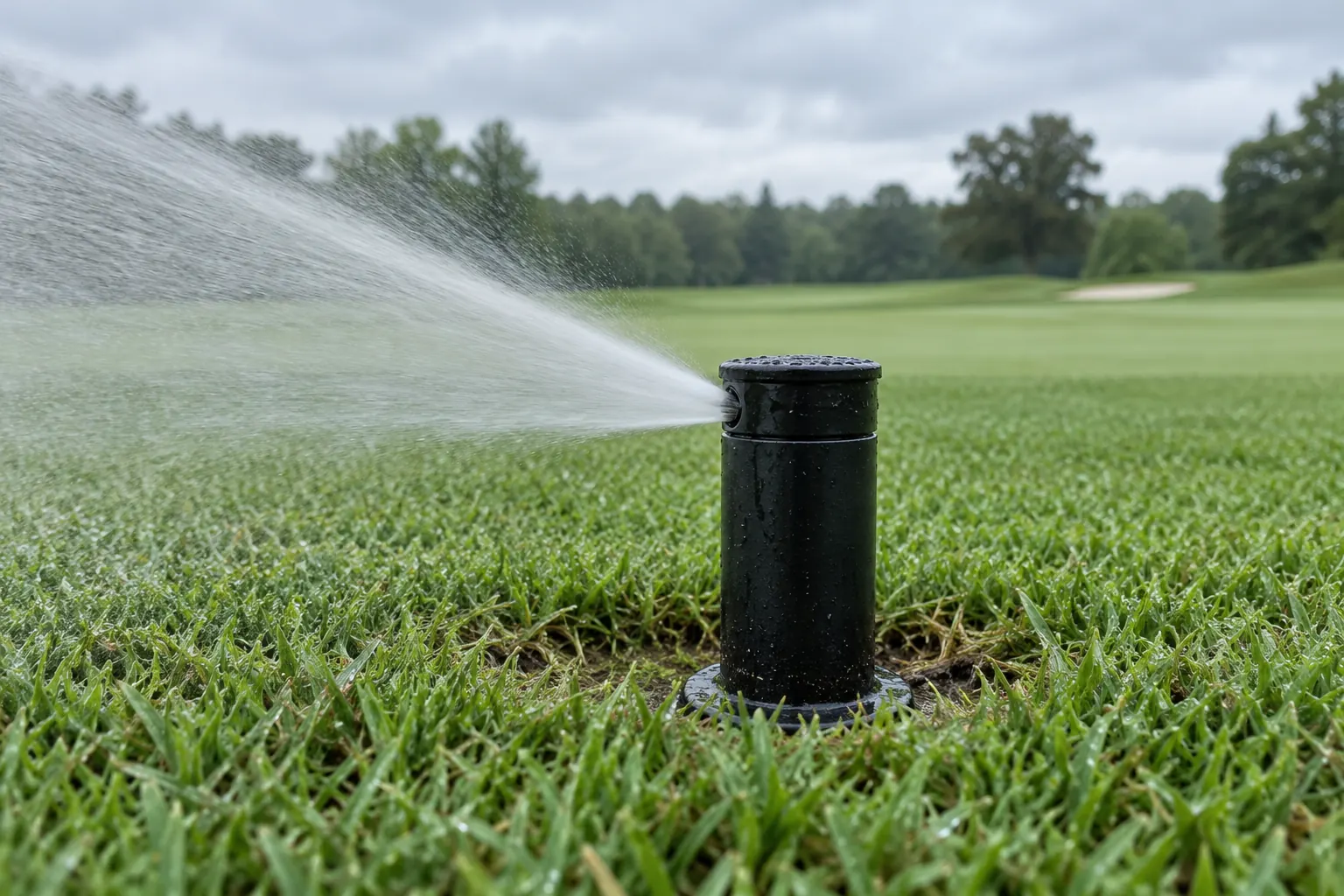
Review sprinkler head spacing and matched precipitation
Head-to-head spacing is 50% sprinkler spacing. In an equilateral triangular pattern, row spacing is sprinkler spacing multiplied by .866.
A zone or system has matched precipitation rates when all heads have similar precipitation rates. As spray arc doubles, flow should also double.
For the field sheet, reserve separate entries for the head spacing, row spacing, arc, nozzle identification, and pressure reading. Use the following calculation section alongside that record.
Calculate sprinkler precipitation rate
Precipitation rate is the speed at which a sprinkler or irrigation system applies water.
Use manufacturer catalogs for rotor and spray sprinkler flow rates at measured pressure. Estimate total zone flow by summing all sprinkler flow rates on that zone.
Total-area calculation
PR = (FR × 96.3)/A, with PR in inches per hour, FR in gpm and A in square feet.
For a metric calculation using total sprinkler flow for the area: P.R. (mm/hr) = Flow (l/min) x 60 / Total Area (m2).
Head-and-row-spacing calculation
Use the sprinkler spacing formulas when heads in a zone have the same spacing, flow rate and arc of coverage. P.R. (mm/hr) = Flow Rate (l/min) x 21,600 / (Degrees of Arc x Head Spacing (m) x Row Spacing (m)).
Published catch-can example
Follow the teaching example in New Mexico State University’s Turfgrass Irrigation: The published catch-can example ran for 30 minutes. The published example averaged 0.43 inch of caught water. The published example calculates 0.86 inch per hour as 0.43/30 × 60.
Prepare and run the catch-can audit
Use the New Mexico State University pop-up sprinkler audit procedure for the following setup checks. Its rotor placement instruction below applies to irregularly shaped areas.
- Repair problems before proceeding with the audit.
- If possible, audit at the same time of day as normal irrigation.
- Choose a calm day with winds less than or equal to 5 mph.
- A minimum of 24 catch cans are needed for reliable results.
- Catch cans are receptacles of uniform size.
- For rotor sprinklers in irregularly shaped areas, place catch cans in a rough grid 10 to 20 ft apart.
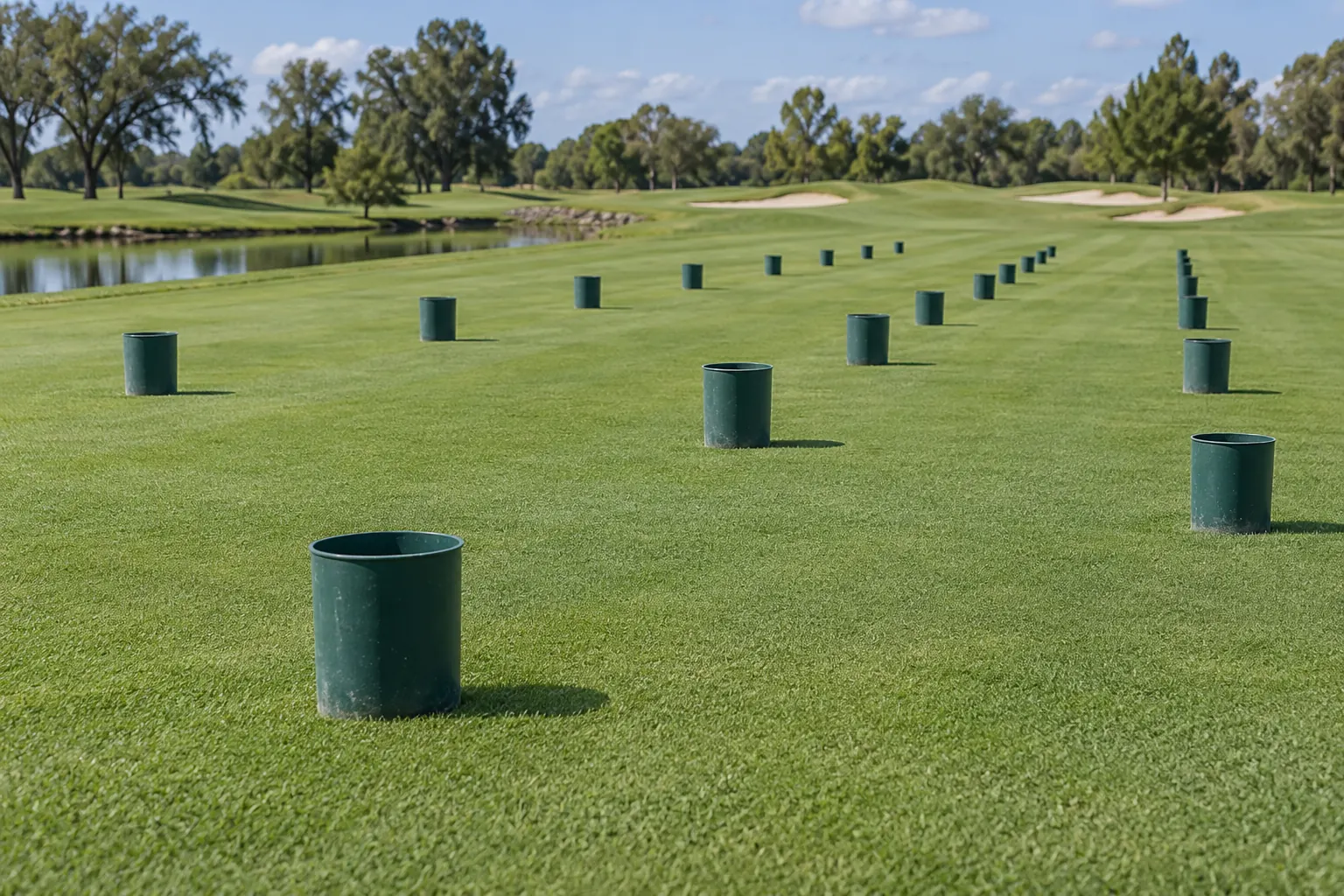
For adjacent zones, use the NC State procedure where similar sprinklers contribute water to each other: Run contributing adjacent zones for equal times and measure catches after all contributing zones have run.
Measure and record the volume in each catch container in milliliters (mL).
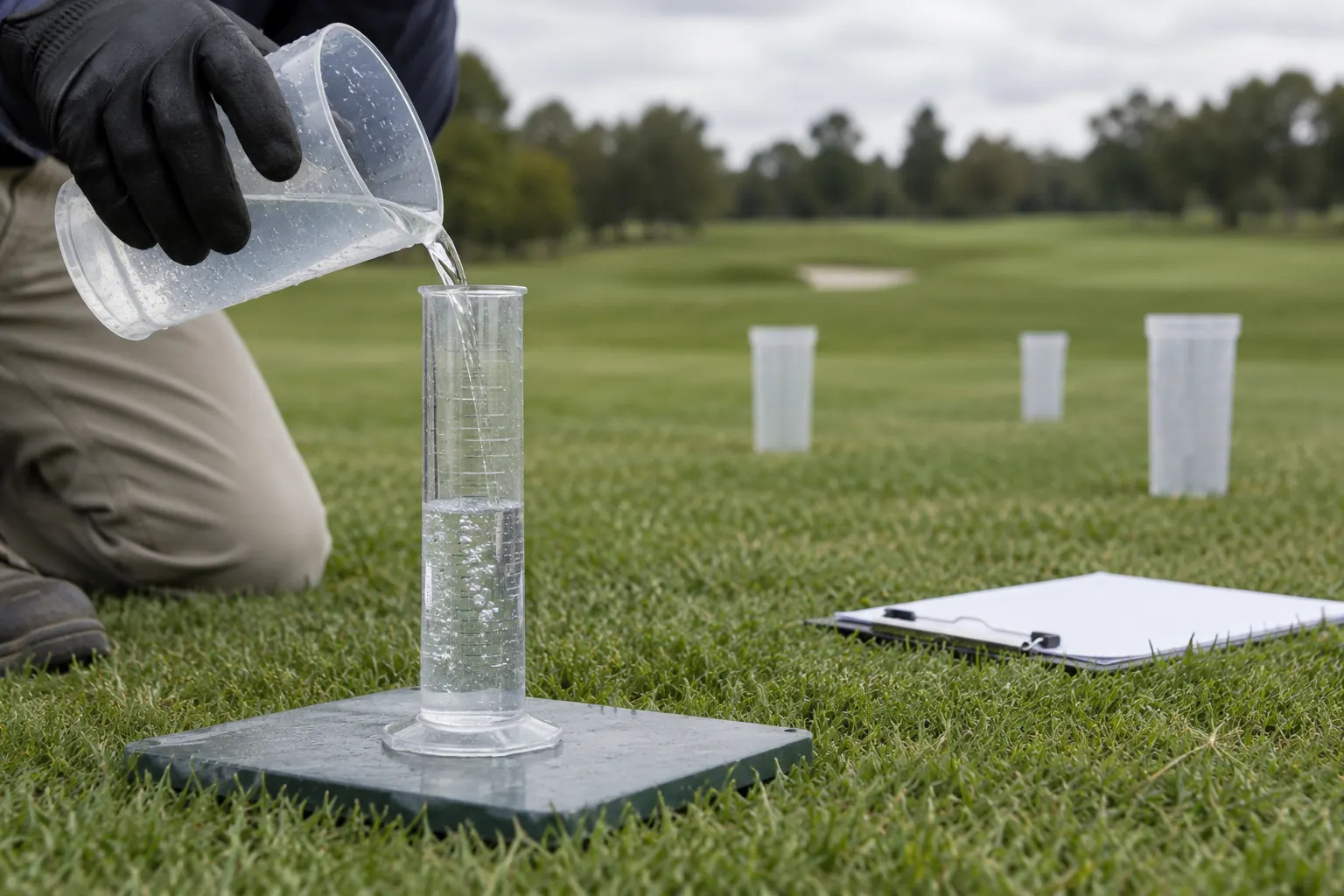
Calculate low-quarter distribution uniformity
Arrange catch-can data from smallest to largest before calculating uniformity. Low-quarter distribution uniformity is the mean of the driest 25% of cans divided by the mean of all cans.
For 24 catch cans, use the six cans collecting the least water for the lowest-quarter average. Multiply the lowest-quarter average divided by the total average by 100 to express uniformity in percent.
For interpretation, use the rotor category in New Mexico State University’s sprinkler rating table:
- Rotor low-quarter distribution uniformity rated Excellent is 0.80.
- Rotor low-quarter distribution uniformity rated Good is 0.65.
Field record to complete
Keep the audit record beside the area map. Fill in the following headings for the area under review:
- Area and sprinkler identification
- Pump and nozzle pressure readings
- Head spacing, row spacing, and arc
- Catalog flow lookup and zone-flow calculation
- Audit run time and individual catch volumes
- Average catch and lowest-quarter average
- Precipitation rate and distribution uniformity
- Inspection findings and repair record
Return to the pressure and sprinkler checks when reviewing the record. For related course topics, browse sports facilities.
Sources
- The R&A — Irrigation System: Audit
- Rain Bird — Landscape Irrigation Design Manual
- Hunter Industries — Product Catalog, Precipitation Rates
- Hunter Industries — Irrigation Notes: Scheduling Irrigation
- New Mexico State University — Turfgrass Irrigation
- New Mexico State University — How to Perform a Catch Can Irrigation Audit on a Home Lawn Sprinkler System
- NC State Extension — Landscape Irrigation Auditing Made Simple